Nifirtiti For Exporting Strawberries: Fresh and Frozen Strawberry Export 2026
Here’s a more natural version of that paragraph:
Nifirtiti For Exporting Strawberry ships both fresh and frozen strawberries around the world, backed by a cold chain that runs unbroken from the moment of harvest right up to delivery. Fresh berries are picked, sorted by grade, pre-cooled, and flown out so they arrive with their texture and flavor intact.
Frozen strawberries take a different route — they’re individually quick frozen (IQF), which extends shelf life and makes sea shipping a more cost-effective option.
The company also handles organic strawberry export, working with certified organic farms that offer full traceability and lab-tested checks for residues. Between steady supply, proper export paperwork, and quality checks at every stage,
Nifirtiti has built a reputation as a dependable partner for fresh, frozen, and organic strawberry trade.
Note: the original text didn’t actually contain any links, so there was nothing to preserve here. If you meant to include a specific link (like the contact-us or Incoterms link from earlier), just send it over, and I’ll weave it in.
Nifirtiti doesn’t just talk about quality — the way we work is built around standards that buyers can actually verify. Our farms are certified under GlobalG.A.P., and our food safety practices follow both ISO quality management principles and HACCP guidelines from the Food and Agriculture Organization.
When it comes to shipping, we work within the Incoterms framework set by the International Chamber of Commerce, so buyers always know exactly where responsibility shifts from us to them along the way.
This matters because Egypt has become a genuinely important source of fresh produce on the world stage — a trend confirmed by trade figures from the USDA Foreign Agricultural Service and market research from CBI, both pointing to rising demand for Egyptian citrus, grapes, and strawberries in Europe and the Gulf.
Our customers around the world
UAE (Gulf Region)
A strong Gulf destination for fresh Fortuna strawberries, where air-freighted shipments meet retail demand year-round alongside growing interest in IQF frozen for food service.
Jordan & Iraq
Regional overland and short-sea markets where Egyptian strawberries compete on freight cost and delivery speed during Egypt's December–May counter-season window.
Saudi Arabia
High seasonal demand tied to retail and food-manufacturing buyers, with frozen IQF strawberries increasingly used in juice and bakery production across the Kingdom.
European Union
European Union (Netherlands, France & beyond)
A major destination for both fresh Fortuna and frozen Festival strawberries, filling the supply gap during Northern Hemisphere winter months when local growers can't meet demand.
United Kingdom
A retail-focused market prioritizing firm, well-colored fresh fruit like Fortuna and Camarosa, alongside growing demand for organic-certified strawberry lines.
Russia
A steady buyer of frozen IQF strawberries for processing use, offering a reliable market via reefer sea freight during Egypt's extended December–May season.
Nifirtiti, as a strawberry exporter, works off one straightforward promise: fresh and frozen strawberries that meet international food-safety standards on every shipment, not just the good ones. Strawberries are among the most fragile fruits in global trade, and getting them from field to warehouse without losing color, firmness, or flavor takes real experience — not just refrigerated trucks. This article walks through how the export process actually works, what buyers should be checking for, and why the exporter you choose matters more than most people assume.
Why Strawberry Export Is Growing Worldwide
Demand for strawberries keeps climbing across Europe, the Gulf, and North America. Winters in most import markets shut down local growing entirely, so retailers and food manufacturers lean on exporting countries that can supply fruit when their own farms can’t.
A few things explain the trend:
Strawberries sit among the top five most-traded soft fruits globally.
Frozen strawberry demand has jumped, driven largely by its use in juices, jams, and bakery products.
Health-conscious buyers are pushing more interest toward organic strawberry export programs.
We sit right inside this growth, offering both fresh and frozen options so buyers can pick whichever fits their end use.
Fresh Strawberry Export: What It Involves
Harvesting and Grading
It starts in the field. Strawberries have to be picked at the right ripeness — not too soft, not too firm — then graded by size, color, and condition, with any damaged or overripe fruit pulled before packing even begins.
Cooling and Packing
The fruit gets rapidly pre-cooled right after harvest to slow decay. This step isn’t optional — even a few hours’ delay can cut shelf life noticeably. Packing happens in ventilated clamshells or trays built to protect the fruit through transport.
Cold Chain and Shipping
Fresh strawberries move by refrigerated truck and air freight to reach distant markets while they’re still fresh. Nifirtiti For Exporting Strawberry keeps the cold chain unbroken from farm to airport, holding the fruit at the right temperature the whole way.
Frozen Strawberry Export: A Different Process
Frozen export buys buyers a longer shelf life and more room to plan production. It generally runs through these steps:
Washing and sorting the strawberries.
Removing the stems (de-capping).
Individually quick freezing (IQF) to lock in flavor, color, and nutrients.
Packing into bulk bags or retail-ready bags, depending on what the buyer needs.
Storing in blast-freezers at -18°C or lower until shipment.
Frozen strawberries travel by sea in refrigerated containers — a cheaper route for long-distance orders than flying fresh fruit would be.
Organic Strawberry Export: A Rising Niche
Organic strawberry export has grown into a real part of the business for exporters serving health-focused markets. Getting certified means farms have to skip synthetic pesticides and fertilizers, follow strict soil management, and pass regular inspections along the way.
Buyers looking at organic strawberry export tend to check for:
Valid organic certification (EU Organic or USDA Organic)
Full traceability from farm to shipment
Lab results confirming no chemical residues
As one of the best strawberry exporters in the world, our company works with certified organic farms to meet this demand — giving importers clean-label fruit without giving up volume or consistency.

Strawberry Varieties Exported from Egypt
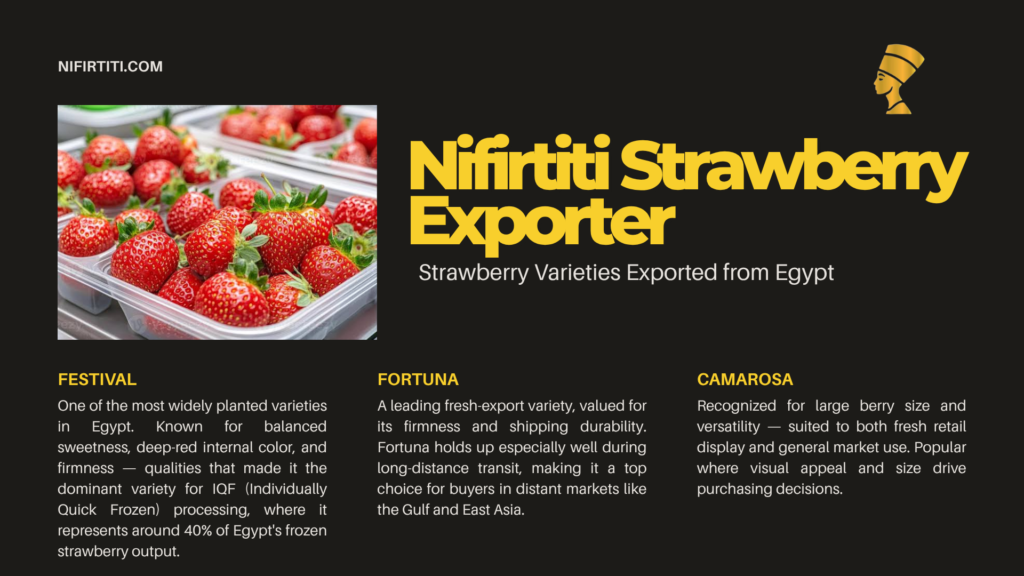
1. Festival
This is one of the most heavily planted varieties in Egypt, and for good reason. It strikes a good balance between sweetness and firmness, with a deep-red color running all the way through the flesh — not just the skin. That combination of traits is exactly why it dominates IQF (Individually Quick Frozen) processing, accounting for roughly 40% of Egypt’s frozen strawberry output.
2. Fortuna (Florida Fortuna)
Fortuna is the go-to variety when the fruit needs to survive a long trip. Its firmness holds up well over extended transit times, which is why it’s become the preferred choice for fresh export to farther-flung markets like the Gulf and East Asia.
3. Camarosa
Camarosa stands out for its size and versatility — large berries that work equally well on a fresh retail shelf or in general market channels. Wherever visual appeal and size are what sell the fruit, Camarosa tends to be the pick.
4. Sensation (Florida127)
According to recent University of Florida IFAS data, Sensation now leads by export volume. It’s a newer cultivar, bred specifically for strong flavor and the kind of consistency exporters need season after season.
5. Florida Beauty
Florida Beauty shows up in both fresh export and IQF frozen volumes, usually grown right alongside Festival and Fortuna in the same fields.
6. Sweet Charlie
Sweet Charlie’s advantage is timing — it ripens earlier than most other varieties, giving buyers access to fruit before the main season really gets going.
7. Albion and Monterey
These two extend the season on the back end, typically becoming available in April and May. They give exporters a way to keep supply flowing past the Fortuna/Festival peak.
PRODUCT SPECIFICATIONS
Egyptian Strawberry Variety Spec Sheet 2026
Available in fresh clamshell and IQF frozen formats throughout Egypt’s winter production window.
| Variety | Notes | Berry Weight | Brix | Packaging | Season |
|---|---|---|---|---|---|
| Festival | Firm, main export variety | 20–30g | 8–10° | 250g/500g clamshells, 5kg cartons | Dec – Mar |
| Sweet Charlie | Early season, aromatic | 18–25g | 9–11° | 250g clamshells | Dec – Feb |
| Fortuna | Large fruit, high yield | 25–35g | 8–9° | 250g/500g clamshells | Jan – Mar |
IQF frozen strawberries are available year-round, independent of the fresh-season window above.
EXPORT PROCESS
From Inquiry to Loaded Container
Same-day harvest-to-pack cold chain.
| Step | Timing | Stage | What Happens |
|---|---|---|---|
| 1 | Day 0 | Inquiry & Sample Request | Specify fresh or IQF, variety, and destination Incoterm. |
| 2 | Day 1–2 | Quotation & Proforma | FOB / CFR / CIF quote issued, proforma confirms schedule. |
| 3 | Day 2–4 | Harvest, Grading & Packing | Same-day harvest-to-pack, cold chain from field to hydrocooler. |
| 4 | Day 4–5 | Certification & Documentation | Phytosanitary certificate and residue report finalized. |
| 5 | Day 5+ | Loading & Shipment | Air freight for fresh (short shelf life), reefer sea for IQF frozen. |
Key Facts Worth Noting
- Harvest season: Egypt’s strawberry season runs roughly December through May/June — a counter-seasonal window that supplies Northern Hemisphere buyers when local production is unavailable.
- Scale: Egypt is the world’s largest exporter of frozen strawberries (around 300,000 tons annually) and ranks third globally in total strawberry production (~688,000 tons).
- Fresh vs. processing split: Fortuna and Camarosa are generally preferred for fresh long-distance export due to firmness; Festival dominates IQF/frozen processing due to its structural integrity and color retention.
Key Benefits of Working With an Established Strawberry Exporter
Quality Control at Every Stage
Fruit gets checked more than once before it ships — right after picking, again before it’s packed, and one last look before it goes on the truck. Catching a bruised or overripe berry at any of those points is a lot cheaper than a rejected pallet at the other end.
Reliable Documentation
Phytosanitary certificates, health certificates, certificate of origin — customs won’t move a shipment without them. A missing form can hold up a container for days, sometimes longer, and that’s fruit sitting in a warehouse instead of on a shelf.
Consistent Supply
Buyers planning around a season need to know the volume will actually show up. That’s the difference an exporter with real structure makes — fewer gaps, fewer scrambles to find a last-minute alternative supplier.
Pros and Cons Buyers Should Weigh
Pros:
- One supplier, both fresh and frozen — no juggling separate vendors
- Organic certification available for buyers targeting premium shelf space
- A cold chain that’s already dialed in, so spoilage stays low
Cons:
- Fresh fruit doesn’t wait — logistics have to move fast, no exceptions.
- Flying fresh fruit costs more than shipping frozen by sea, and that gap shows up in the final price.
- Outside peak harvest, fresh volumes tighten up — worth planning around.
Practical Tips for Importers
- Go frozen for anything processed — jams, juices, bakery fillings. It holds up better over a long trip.
- Go fresh for retail shelves, where how the fruit looks and feels matters as much as taste.
- Ask for a sample shipment first before locking in a bigger order.
- Get the certification paperwork sorted on organic orders before payment terms are finalized — chasing it after the fact only slows things down.
- Time shipments around harvest peaks. Pricing and fruit quality are both better then.
Expert Insight: What Separates a Good Exporter From a Great One
Timing decides almost everything in this business. Whether a berry lands in perfect shape or shows up damaged usually comes down to one thing: how fast it got cold after picking — sometimes it’s a 30-minute window that matters. Exporters running their own on-site cooling, instead of trucking fruit off to third-party storage first, consistently send out a better product. That’s the reasoning behind keeping our pre-cooling and packing right next to the fields — no long, unrefrigerated drive before the fruit ever gets cold.
Common Challenges in Strawberry Export and How They’re Solved
| Challenge | Solution |
|---|---|
| Fruit bruising during transport | Ventilated, shock-absorbing packaging |
| Spoilage from temperature breaks | Continuous cold chain monitoring with data loggers |
| Customs delays | Certificates arranged in advance, labeling done right the first time |
| Inconsistent organic certification | Sourcing only from audited, certified organic farms |
Conclusion
Getting strawberries from the field to a buyer’s warehouse — fresh or frozen — leaves no room for shortcuts. Harvest timing has to be right, the cold chain can’t break, and the paperwork has to be in order before the fruit ever reaches a port. That’s the standard Nifirtiti For Exporting Strawberry has built its whole operation around, and it’s why buyers can count on fresh fruit, frozen fruit, and certified organic strawberry export without second-guessing what’s arriving. If you’re an importer tired of inconsistent suppliers, working with Nifirtiti for exporting strawberries means fewer headaches at customs and fruit that actually looks the way it did when it left Egypt.
See our other soft fruit: Grapes, Pomegranates, and Watermelon. All packed under the same cold-chain standards as our strawberries.
EXPORTED STRAWBERRY
Time has changed
Business Hours
FAQ
1. What is Nifirtiti For Exporting Strawberries?
Nifirtiti For Exporting Strawberry exports fresh and frozen strawberries — including organic strawberry export — to buyers around the world.
2. What is the difference between fresh and frozen strawberry exports?
Fresh strawberries have to move fast, so they’re shipped by air through a tight cold chain. Frozen strawberries go through IQF (individually quick freezing) instead, which means they can travel by sea and hold up over much longer distances.
3. Does Nifirtiti For Exporting Strawberry offer organic strawberry export?
Yes. We source from certified organic farms and keep full traceability on those shipments, along with the certification to back it up.
4. How is strawberry freshness maintained during export?
It comes down to speed and consistency — pre-cooling the fruit right after it’s picked, keeping it refrigerated the whole way through transport, and packing it in ventilated trays that let it breathe without getting damaged.
5. What documents are required for strawberry export?
Every shipment needs a phytosanitary certificate, a health certificate, and a certificate of origin. Organic orders need one more layer on top — valid organic certification to go with the rest.
Request a Quotation