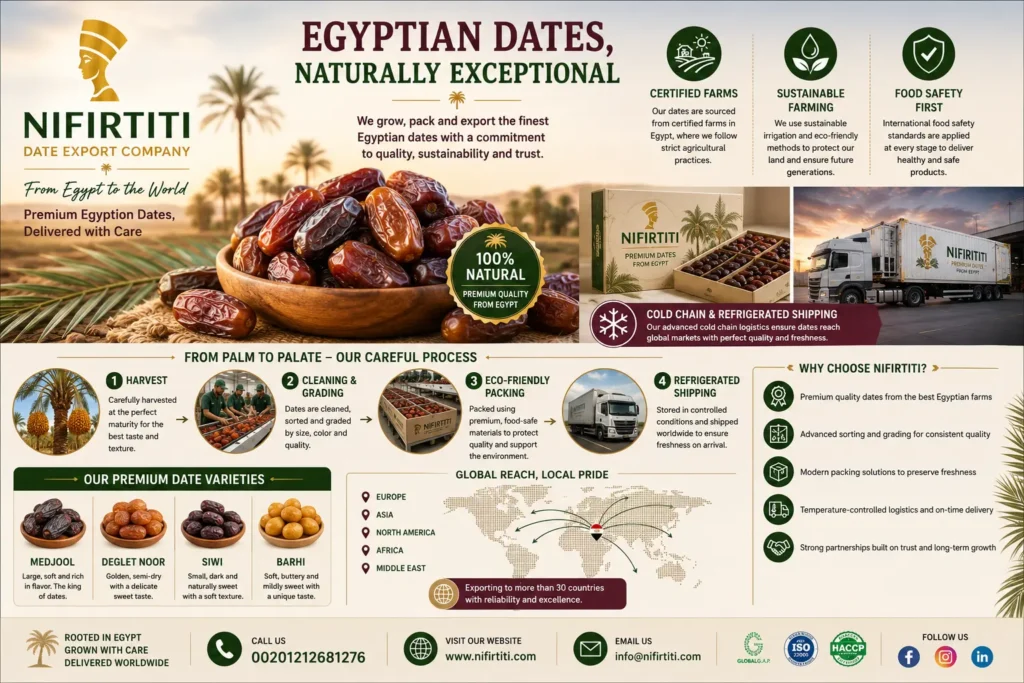
Nifirtiti Date Export Company supplies fresh and dried Egyptian dates to buyers across Europe, the Gulf, and Asia, backed by strict grading, proper moisture control, and full export documentation. This guide explains what makes Egypt a leading date origin and how to choose a dependable supplier.
Nifirtiti Date Export Company has earned trust among importers, wholesalers, and food processors who need a steady supply of high-quality dates from Egypt. Dates are among the oldest cultivated fruits in the world, and Egypt’s deep agricultural history with the date palm gives local exporters a natural edge in flavor, variety, and harvest scale.
Global demand for dates has grown well beyond their traditional markets in the Middle East and North Africa. Health-conscious consumers in Europe, North America, and Asia now buy dates as a natural sweetener and snack, prompting buyers to look closely at date exporters in Egypt for consistent supply. Egypt ranks among the top date-producing countries globally, and companies like Nifirtiti Date Export Company play a central role in moving that harvest to international markets.
This article covers what distinguishes a reliable date exporter from a risky one, how the export process works from the palm to the port, and what buyers should verify before placing an order.
Why Egypt Is a Leading Date Export Origin
Egypt has cultivated date palms along the Nile Valley and in oases for thousands of years, and that long history translates into deep knowledge of variety and established farming infrastructure. The country produces more dates by volume than almost any other nation, though much of that volume historically stayed in domestic and regional markets before export demand caught up.
Key reasons buyers source from date exporters in Egypt include:
- Wide variety range, from soft Zaghloul dates to dry Siwa varieties suited for long shelf life.
- Large production volume, supporting both small wholesale orders and full-container shipments.
- Lower production costs compared to some Gulf origins, improving price competitiveness.
- Established port infrastructure, with direct shipping routes to Europe and the Mediterranean basin.
Common Date Varieties Exported from Egypt
Export shipments from Egypt typically center on a handful of well-known varieties:
- Zaghloul – soft, semi-fresh texture, popular for retail markets during the early harvest season.
- Siwa – dry, long shelf life, ideal for sea freight and long-term storage.
- Samani – firm texture with balanced sweetness, used in both retail and processing.
- Hayany – dark, soft flesh, often sold fresh during peak season.
A capable exporter, including Nifirtiti Date Export Company, matches variety selection to the buyer’s intended use, whether that’s retail packaging, food processing, or bulk paste production.
What Makes Nifirtiti Date Export Company Stand Out
Buyers evaluating date suppliers usually ask the same core questions: Is the product consistent? Is the paperwork accurate? Will the shipment clear customs without delay? Nifirtiti Date Export Company is built around answering all three through disciplined sourcing and quality checks.
Grading and Quality Standards
Export-grade dates pass through several checks before packing:
- Moisture content testing, typically targeting 18–24% for soft varieties and below 15% for dry varieties
- Size and color sorting to separate premium grades from local-market fruit
- Visual inspection for skin damage, mold, or insect activity
- Pesticide residue testing to meet destination-market limits, particularly for EU-bound shipments
Skipping moisture testing is one of the most common causes of spoilage during long shipments, since dates above safe moisture thresholds can ferment in transit.
Packaging for Long-Distance Shipping
Fresh and semi-dry dates are packed in ventilated cartons or vacuum-sealed trays, depending on the variety and shelf-life target. Dry varieties like Siwa tolerate standard cartons well, while softer varieties such as Zaghloul often need cold storage and tighter humidity control throughout transit.
A trustworthy exporter provides:
- Phytosanitary certificate
- Certificate of origin
- HACCP or ISO 22000 food safety certification
- Pesticide residue lab reports for sensitive markets like the EU
Buyers should request certificate numbers and verify them with the issuing authority rather than accepting a scanned copy without confirmation.
Benefits and Trade-Offs of Sourcing Dates from Egypt
| Factor | Egyptian Dates | Competing Origins (e.g., Saudi Arabia, UAE) |
|---|
| Variety range | Very wide (Zaghloul, Siwa, Samani, Hayany) | Often narrower, brand-focused (e.g., Medjool, Ajwa) |
| Price competitiveness | Generally lower | Often higher, premium positioning |
| Shelf life (dry varieties) | 12+ months under proper storage | Similar for dry-pressed varieties |
| Shipping access | Strong via the Mediterranean and Suez routes | Strong within the Gulf and Asia |
| Documentation complexity | Standard EU/Gulf requirements | Similar requirements |
Pros of working with an established Egyptian exporter:
- A broad variety selection covers retail, processing, and bulk needs
- Competitive pricing due to a large domestic production base
- Strong shipping access to European and Mediterranean markets
Cons to watch for:
- Quality can vary between smaller farms without strict moisture control
- Peak-season demand can extend lead times for fresh varieties
- Buyers must confirm specific certifications required for their destination market
Practical Steps for Buyers Sourcing Dates from Egypt
- Request a sample shipment first. Test moisture content, texture, and flavor before committing to a full container order.
- Verify certifications independently. Confirm phytosanitary and food safety certificates directly with the issuing body.
- Ask about moisture and storage control. Confirm how the exporter manages humidity during storage and transit for the specific variety ordered.
- Clarify Incoterms upfront. FOB, CIF, and CFR terms determine who covers shipping costs and risk at each stage of transit.
- Start with a trial order. Even experienced buyers benefit from testing a new supplier with a partial shipment before scaling to full volume.
Expert Insight: What Experienced Importers Look For
Buyers who have sourced dates internationally for years tend to offer consistent advice: judge a supplier based on multiple shipments rather than a single strong sample. Date quality can vary between harvest batches, especially for soft varieties that are sensitive to humidity and storage time.
Experienced importers also watch how exporters handle peak-season constraints. A reliable company communicates clearly when certain varieties will be limited near the end of a harvest window, rather than overpromising volume they cannot deliver. This kind of honesty is a stronger signal of long-term reliability than price alone.
For buyers targeting the European market specifically, checking pesticide residue results for every batch — not just the first one — helps avoid customs holds that can delay an entire shipment.
Common Mistakes Buyers Make
- Selecting price over moisture and quality testing
- Skipping sample evaluation before a full container order
- Not confirming food safety certifications required by the destination country
- Overlooking storage conditions for soft, fresh-style varieties
- Ignoring Egypt’s seasonal harvest calendar when planning inventory
Avoiding these mistakes often determines whether an import relationship lasts a single order or grows into a long-term partnership.