


Nifirtiti: Egypt's Trusted Pomegranate Exporters

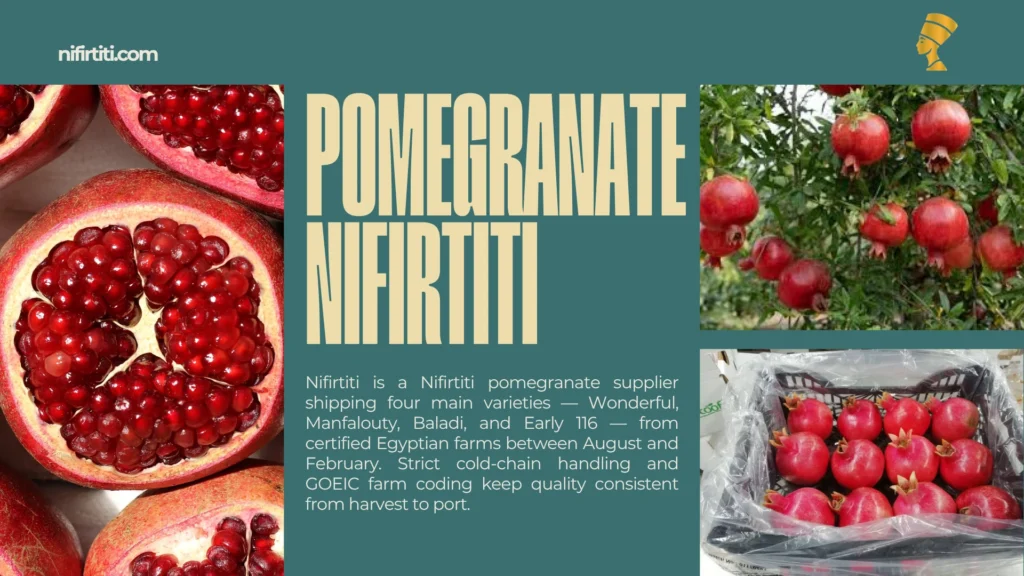
This guide explains why Nifirtiti ranks among Egypt’s leading pomegranate exporters. It covers the four varieties the company ships — Wonderful, Manfalouty, Baladi, and Early 116 — Egypt’s growing regions, and the GOEIC certification that legitimate exporters require. Readers will learn packaging standards, cold-chain shipping practices, and the practical steps for importing pomegranates from Egypt, alongside real export data on markets, volumes, and pricing. The article closes with five frequently asked questions covering certifications, shipping seasons, packaging, and minimum order quantities.

Pomegranate Export
Pomegranate Export
Pomegranate Exporters
Nifirtiti Expo

Nifirtiti Expo

Typically replies within a day

Hey, Do you want to talk with us?


Where Egyptian Pomegranates Are Exported

Egypt shipped pomegranates to 52 markets in the first nine months of 2025. The destination list shows where demand is strongest and where new opportunity is opening up:

  • UAE — the largest single market, accounting for roughly half of Egypt’s total pomegranate export value.
  • Syria — the second-largest destination by value, reflecting strong regional demand across the Middle East.
  • Russia — a smaller but steady buyer, with volume growing year over year.
  • The European Union — a growing destination as retailers look for an early-season alternative to Spanish and Turkish supply.
  • China — recently opened to official Egyptian pomegranate imports, adding a major new long-term outlet.

Trade analysts have pointed to the Netherlands, the UAE, and France as the markets with the most room for further growth over the next few years. For a fresh pomegranate export company, that spread of destinations matters because it reduces dependence on any single buyer or region absorbing a bad season elsewhere.

What Sets Nifirtiti Apart From Other Pomegranate Exporters

Not every fresh pomegranate export company can guarantee the same fruit twice. Buyers comparing suppliers usually weigh a short list of factors:

  • Farm certification — GOEIC coding confirms a farm avoids hazardous pesticide practices, a requirement for legal export.
  • Cold-chain discipline — fruit moved into 5°C to 7°C storage shortly after harvest, not left exposed in open crates.
  • Packaging control — cartons and trays sized and labeled to match each destination market’s retail standard.
  • Documentation readinessphytosanitary certificates and HS code paperwork (0810.90.10) prepared ahead of shipping.

Pros and Cons for Importers

  • Pro: Four varieties available across a five-month window, reducing the need to switch suppliers mid-season.
  • Pro: Farm-level certification lowers the risk of shipments being rejected at customs.
  • Pro: Documentation prepared before booking shortens clearance time at the destination port.
  • Con: Peak months (October–November) see heavy demand, so booking reefer space early matters.
  • Con: Container minimums may not suit very small, first-time buyers without a partner to combine orders.

Buyers searching for pomegranate exporters near me on a map should still apply these same checks to any local sourcing agent, since certification and cold-chain discipline matter more than physical proximity to a port.

Pomegranate Export Packaging Standards

Packaging protects fruit that bruises easily and must survive several weeks in transit. Standard formats used across the trade include:

  • 4 to 5 kg open-top cartons with a label and protective tray, the most common format for retail-ready fruit.
  • 20 kg plastic trays, typically used for bulk pomegranate for export destined for repacking or juice processing.
  • 180 to 210 cartons per pallet, with roughly 20 pallets loading into a single 40-foot reefer container.
  • Size grading from 6 to 14, based on fruit diameter, so buyers receive a consistent calibre in every carton.

Getting packaging specs agreed before the first shipment avoids the most common dispute in the trade: a buyer expecting one carton format receiving another.

Pomegranate Shipping and Cold-Chain Logistics

Pomegranates hold up better than most fresh fruit during long transport, but only if the cold chain starts early.

  • Pre-cooling within hours of harvest brings fruit down toward the 5°C to 7°C storage range recommended for the fruit, slowing moisture loss through the skin.
  • Reefer containers are the standard for sea freight, holding steady temperature and humidity for voyages that can run several weeks to Europe or the Gulf.
  • Continuous temperature logging during the voyage gives buyers a documented record if any shipment arrives underperforming.
  • HS code 0810.90.10 should appear on all export documentation to avoid customs delays at the destination.

Buyers who ask about pre-cooling times and reefer settings before confirming an order are far more likely to receive fruit that matches the sample they were shown.

Practical Steps to Import Pomegranates From Nifirtiti

  1. Confirm the variety and season window. Early 116 ships from late August; Wonderful follows from around mid-September through the peak of the season into December.
  2. Request farm certification and lab documentation. Ask for GOEIC coding details and recent phytosanitary paperwork before confirming volume.
  3. Agree on packaging format. Choose between cartons and plastic trays, and confirm size grading, before the first container is booked.
  4. Lock in the shipping method. Reefer sea freight is standard for most orders; confirm container size and pallet count against your order volume.
  5. Verify documentation before loading. HS code, phytosanitary certificate, and any destination-market import permits should be confirmed before the container seals.
  6. Track the cold chain. Request a temperature log for the voyage so any deviation is documented rather than disputed after arrival.

Real-World Example: Meeting a Multi-Market Order

A recent order for a Gulf-based wholesale buyer needed three varieties timed to different retail campaigns: Early 116 for an early-season promotion, Wonderful for the peak-season push, and Baladi for a smaller regional market with strong demand for the traditional flavor profile. Sequencing the three varieties across twelve weeks meant the buyer never had to source a second supplier mid-season, and matching phytosanitary paperwork on each shipment let customs clearance move faster at the destination port than on previous orders sourced from multiple smaller farms.

The same order also highlighted why farm-level certification matters more than it might seem on paper. One competing quote came in lower per kilogram, but the supplier could not immediately confirm GOEIC coding for the originating farm. Rather than risk a shipment held at customs, the buyer stayed with the certified source and treated the price difference as the cost of predictable clearance — a trade-off experienced importers make routinely once they have been burned by a delayed container even once.

Common Challenges Facing Pomegranate Exporters

  • Challenge: Fruit splitting or softening in transit. Solution: pre-cooling immediately after harvest and steady reefer temperatures through the voyage.
  • Challenge: Inconsistent sizing between shipments. Solution: grading by size class (6–14) before packing, shared with buyers in advance.
  • Challenge: Customs delays over certification. Solution: confirming GOEIC farm coding and HS code documentation before the vessel is booked.
  • Challenge: Seasonal supply gaps. Solution: sequencing Early 116, Wonderful, Baladi, and Manfalouty across the full August-to-February window.

Conclusion

Choosing among pomegranate exporters comes down to whether a supplier can repeat the same certified, well-packed shipment order after order, not just deliver one good container. Nifirtiti’s four-variety lineup, GOEIC-certified sourcing, and documentation prepared ahead of shipping are why buyers across the Gulf, Europe, and Asia keep a Nifirtiti pomegranate supplier relationship on their shortlist season after season. For importers weighing options this year, the same checks apply whether Nifirtiti or another exporter is under consideration: confirm the variety window, verify farm certification, and agree on packaging before the first container ships.

Frequently Asked Questions

1. What pomegranate varieties does Nifirtiti export?

Nifirtiti ships four main varieties: Wonderful, Manfalouty, Baladi, and Early 116, covering the full Egyptian season from late August through February.

2. When does the Egyptian pomegranate export season run?

Early 116 opens the season in late August, Wonderful follows from around mid-September, and the export window extends through December, with some volume continuing into February.

3. What certification should buyers verify before ordering?

Ask for GOEIC farm coding, which confirms the farm avoids hazardous pesticide use, along with a current phytosanitary certificate and the correct HS code (0810.90.10).

4. What packaging formats are standard for pomegranate exports?

Most shipments use 4 to 5 kg open-top cartons or 20 kg plastic trays, loaded roughly 180 to 210 cartons per pallet, with about 20 pallets per 40-foot reefer container.

5. Is there a minimum order quantity for wholesale pomegranate suppliers?

Minimum orders are typically set at the container level for sea freight; smaller buyers can often combine orders with a partner importer to meet that minimum.

Suggested Image Alt Text

  •  
  • Egyptian pomegranate orchard in Nubaria growing region
  • Reefer container loading Egyptian pomegranates for export
  • Hand-grading Manfalouty pomegranates before export packing
  • Baladi pomegranate cluster ready for international shipment
  • GOEIC-certified pomegranate farm inspection in Egypt
Fresh Wonderful pomegranates packed for export by Nifirtiti
Egyptian pomegranate exporters

Why Egypt Has Become One of the World’s Leading Pomegranate Exporters

Egyptian pomegranate exports rose roughly 40% in value during the first nine months of 2025, reaching close to 78 million US dollars and placing pomegranate among Egypt’s top ten agricultural export commodities. Egypt now ships around 247,000 tonnes of pomegranates a season, with the UAE alone accounting for about half of total export value.

Growing Regions Behind Egypt’s Pomegranate Trade

Three regions drive most of Egypt’s supply:

  • Nubaria — the largest production zone, responsible for the majority of national output.
  • Assiut (Upper Egypt) — hot days and cool nights that concentrate sugar and deepen aril color.
  • Beheira — a smaller but steady contributor that adds volume during peak months.

Spreading production across these regions lets Egyptian pomegranate exporters maintain supply even when one area faces a weaker harvest.

How Nifirtiti Earned Its Place Among Trusted Exporters

Fresh pomegranate export companies compete on more than price. Nifirtiti built its name through habits buyers notice on repeat orders:

  1. Sourcing only from GOEIC-coded farms that are certified free of hazardous pesticide use.
  2. Grading fruit by size and color before packing, not relying on a single automated pass.
  3. Sharing phytosanitary documentation with buyers before the vessel books, not after a dispute.

Best Pomegranate Variety for Export: What Nifirtiti Ships

Buyers rarely order just one variety, since each fills a different market need across the season. Here is what Nifirtiti supplies:

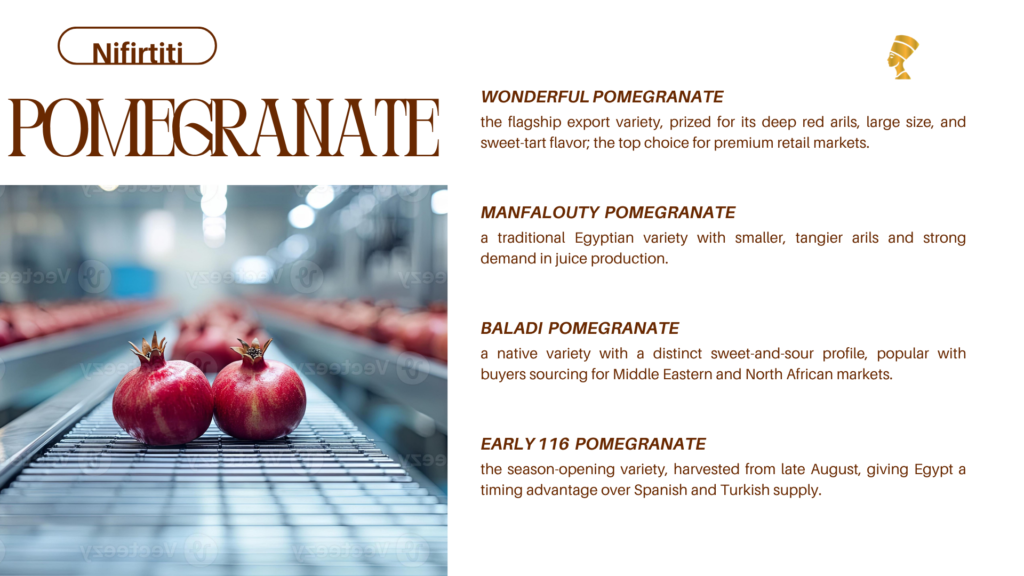
  • Wonderful — the flagship export variety, prized for its deep red arils, large size, and sweet-tart flavor; the top choice for premium retail markets.
  • Manfalouty — a traditional Egyptian variety with smaller, tangier arils and strong demand in juice production.
  • Baladi — a native variety with a distinct sweet-and-sour profile, popular with buyers sourcing for Middle Eastern and North African markets.
  • Early 116 — the season-opening variety, harvested from late August, giving Egypt a timing advantage over Spanish and Turkish supply.

This four-variety lineup is one reason Nifirtiti is often named among the best pomegranate varieties for export choices when buyers compare Egyptian suppliers against origins like Spain, Turkey, India, and Peru.

  1. Interested in more Egyptian produce? Nifirtiti also exports Garlic, strawberries, Dates, grapes, Mango, Lemon, Onion, Watermelon, Potato, and Orange, all sourced from the same trusted farms.
ExportBureau profile