Egyptian sweet potato exporter Europe
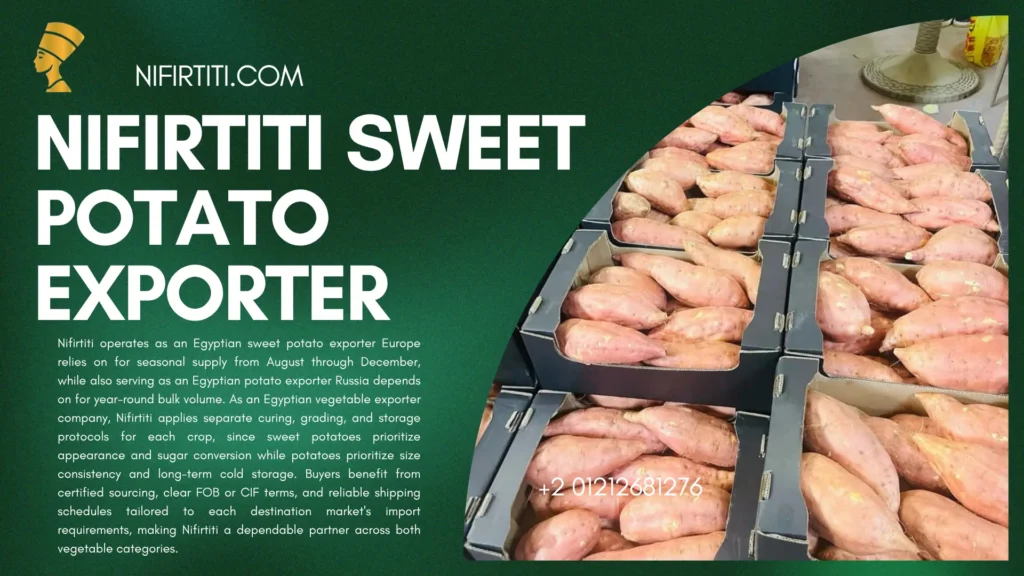
Nifirtiti operates as an Egyptian sweet potato exporter Europe relies on for seasonal supply from August through December, while also serving as an Egyptian potato exporter Russia depends on for year-round bulk volume. As an Egyptian vegetable exporter company, Nifirtiti applies separate curing, grading, and storage protocols for each crop, since sweet potatoes prioritize appearance and sugar conversion while potatoes prioritize size consistency and long-term cold storage. Buyers benefit from certified sourcing, clear FOB or CIF terms, and reliable shipping schedules tailored to each destination market’s import requirements, making Nifirtiti a dependable partner across both vegetable categories.
Quick summary: Nifirtiti is an established Egyptian sweet potato exporter Europe relies on for steady, certified supply during the August-to-December season. The company also operates as an Egyptian potato exporter Russia trusts, giving the business strong year-round demand across two major vegetable categories.
Nifirtiti has grown into a dependable Egyptian sweet potato exporter Europe importers turn to when local harvests can’t cover demand. As an Egyptian vegetable exporter company, Nifirtiti understands that sweet potatoes and table potatoes serve very different markets — one driven by health-conscious retail demand in the EU, the other by steady wholesale volume into markets like Russia. This article explains how Egyptian vegetable export actually works for these two crops, what buyers should verify before ordering, and why pairing sweet potato and potato supply under one exporter makes sense for businesses sourcing both.
Why Europe Sources Sweet Potatoes From Egypt
European demand for sweet potatoes has grown steadily as the vegetable shifted from a niche item to a mainstream retail staple. Egypt fits this demand well because:
- Egyptian sweet potatoes are available from roughly August through December, filling a key supply window
- EU imports of Egyptian sweet potatoes have grown by more than 20% year over year in recent seasons
- Egypt’s climate supports strong yields without the storage losses that affect some Northern European crops
This growth is exactly why an Egyptian sweet potato exporter Europe can rely on tends to win long-term contracts over smaller, inconsistent suppliers — European retailers need predictable volume across the full season, not just a strong first shipment.
How Nifirtiti Operates as an Egyptian Sweet Potato Exporter Europe Trusts
Harvesting and Curing
Sweet potatoes need a curing period after harvest — typically several days in warm, humid conditions — to heal minor skin wounds and convert starches to sugars, which improves both flavor and shelf life. Skipping this step is one of the most common causes of early spoilage in transit.
Grading and Sizing
Export-grade sweet potatoes are sorted by size and shape, since European retail buyers usually want uniform, blemish-free tubers for shelf display, while food processing buyers care more about consistent dry matter content than appearance.
Storage and Shipping
Properly cured sweet potatoes can be stored at around 13-15°C with controlled humidity, extending availability beyond the main harvest window. Shipments to Europe typically move by sea in ventilated containers, given the relatively short transit distance from Egyptian ports.
How Nifirtiti Serves as an Egyptian Potato Exporter Russia Relies On
Table potatoes follow a different export logic than sweet potatoes. Russia has long depended on imported potatoes to supplement domestic production, particularly during off-season months. An Egyptian potato exporter Russia trusts needs to manage:
- Larger bulk volumes than sweet potato shipments typically require
- Strict size grading, since Russian wholesale buyers usually specify exact size bands
- Cold storage capability to supply potatoes outside Egypt’s main harvest period
Because potatoes store longer than sweet potatoes when properly cooled, this category supports more consistent bulk ordering throughout the year — a different rhythm from the seasonal sweet potato trade with Europe.

Benefits, Pros, and Cons of Sourcing Both Crops From One Exporter
Benefits
- One Egyptian vegetable exporter company can serve both EU retail and Russian wholesale needs
- Diversified product lines reduce the exporter’s dependency on a single market or season
- Shared logistics infrastructure (cold storage, packing lines) often improves pricing for buyers
Pros and Cons
Pros:
- An Egyptian sweet potato exporter Europe trusts typically already understands EU import compliance, reducing onboarding friction
- Buyers sourcing multiple vegetables avoid managing several supplier relationships
- Combined volume across crops can strengthen pricing leverage for the exporter
Cons:
- Sweet potato and potato seasons don’t fully overlap, so supply planning requires advance scheduling
- Quality standards differ significantly between the two crops and must be managed separately
- Storage requirements (humidity and temperature) differ, requiring separate facilities
Practical Steps for Buyers Sourcing Egyptian Vegetables
- Confirm season alignment — sweet potato season runs roughly August to December, while potato supply can extend further with proper storage.
- Request grading specifications separately for each crop, since size and appearance standards differ.
- Ask about storage capacity if you need supply outside the main harvest window.
- Verify phytosanitary certification for your specific destination, since EU and Russian import rules differ.
- Clarify Incoterms (FOB or CIF) early so total landed cost is clear before finalizing volume.
Expert Insight: What Makes a Vegetable Exporter Reliable Across Markets
Serving two markets with different expectations is harder than it looks. An Egyptian sweet potato exporter Europe relies on for retail-ready tubers needs a completely different grading mindset than an Egyptian potato exporter Russia depends on for bulk wholesale volume. Exporters who treat these as the same process usually disappoint one side or the other. Nifirtiti’s approach as an Egyptian vegetable exporter company has been to run separate grading and storage protocols for each crop, rather than applying one generic standard — a distinction that consistently shows up in fewer rejected shipments and steadier repeat orders.
For standard potato varieties, see Nifirtiti Potato Export. European buyers often combine potato orders with our garlic and onion shipments for full FCL loads.
Conclusion
Sourcing sweet potatoes and potatoes from Egypt requires understanding two different harvest calendars, grading standards, and storage needs. Nifirtiti has built its operations to meet both, functioning as a trusted Egyptian sweet potato exporter Europe relies on while also serving as an Egyptian potato exporter Russia depends on for bulk supply. For buyers managing multiple vegetable categories, working with one capable Egyptian vegetable exporter company means fewer supplier relationships to manage and steadier quality across every shipment.
FAQ
1. When is Egyptian sweet potato season for export to Europe? Egyptian sweet potatoes are typically available for export from August through December, with proper storage extending availability slightly beyond that window.
2. What makes Nifirtiti a reliable Egyptian sweet potato exporter Europe trusts? Nifirtiti follows proper curing, sizing, and storage protocols specific to sweet potatoes, along with EU-compliant certification and documentation.
3. How does potato export to Russia differ from sweet potato export to Europe? Potato export to Russia typically involves larger bulk volumes and longer-term cold storage, while sweet potato export to Europe follows a tighter seasonal retail calendar.
4. What certifications should buyers expect from an Egyptian vegetable exporter company? Look for GlobalGAP, ISO 9001:2015, HACCP compliance, and valid phytosanitary certificates matched to the destination country’s requirements.
5. Can one exporter supply both sweet potatoes and potatoes reliably? Yes, an experienced Egyptian vegetable exporter company can manage both crops, provided it maintains separate grading and storage protocols for each.
Image Alt Text Suggestions
- “Egyptian sweet potato exporter Europe grading tubers before packing”
- “Egyptian potato exporter Russia loading bulk shipment containers”
- “”
- “Cold storage warehouse for Egyptian vegetable exporter company”
- “”
Our customers around the world
European Union
European Union (Netherlands, Germany, France & beyond)
Nifirtiti's core sweet potato market, driven by retail demand from August through December when Egyptian supply fills the gap left by Northern European harvests. Shipments move in ventilated containers suited to the crop's curing and humidity needs.
United Kingdom
United Kingdom
A retail-focused sweet potato market with the same uniform, blemish-free sizing standards UK supermarkets apply across fresh produce, sourced during Egypt's August–December window.
Russia
Russia
The primary market for Nifirtiti's table potatoes, sourced for year-round bulk wholesale volume via cold storage rather than seasonal supply, filling gaps in domestic Russian production.
Request a Quotation