
Nifirtiti: Egypt's Leading Grapes Exporters You Can Trust
This guide explains why Nifirtiti ranks among Egypt’s most reliable grapes exporters. It covers the ten grape varieties the company ships — including Flame Seedless, Thompson Seedless, Crimson Seedless, and Red Globe — and explains the growing conditions in the Nile Delta and Upper Egypt that make Egyptian grapes competitive on price and quality. Readers will learn the practical steps involved in importing grapes from Egypt, common challenges international buyers face, and how proper cold-chain handling protects fruit during long-distance shipping. The article closes with five frequently asked questions covering certifications, shipping seasons, minimum order quantities, and quality guarantees.
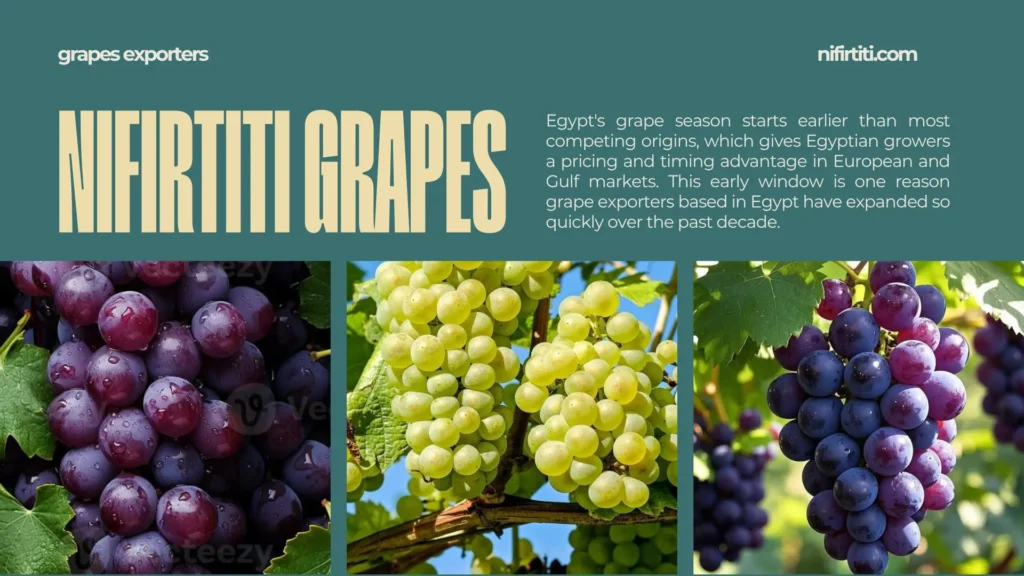

Why Egypt Has Become a Major Force Among Global Grapes Exporters
Egypt’s grape season starts earlier than most competing origins, which gives Egyptian growers a pricing and timing advantage in European and Gulf markets. This early window is one reason grape exporters based in Egypt have expanded so quickly over the past decade.
Climate and Growing Regions That Favor Quality Grapes
Two regions drive most of Egypt’s grape production:
- Nile Delta — cooler, humid conditions suited to seedless varieties with thinner skins.
- Upper Egypt (Minya, Assiut, Luxor) — hot, dry days and cool nights that push sugar content up and extend the harvest window into early summer.
This split lets exporters offer a longer supply season than single-region competitors, which matters to buyers who need steady shelf stock rather than a short burst of fruit.
How Nifirtiti Built Its Reputation
Nifirtiti did not build its name in a crowded field by shipping the largest volume alone. The company earned trust through three habits that buyers repeatedly mention:
- Grading fruit by hand before packing, not just by machine sizing.
- Running pre-cooling on every batch before it leaves the packhouse.
- Sharing lab test results for pesticide residue with buyers before shipment, not after a complaint.
Ten Grape Varieties Nifirtiti Ships to International Buyers
Buyers rarely want just one variety. A single order often mixes early, mid, and late-season grapes so retailers can keep shelves full for months. Here are the varieties Nifirtiti supplies:
- Flame Seedless — small, crisp, deep red berries; one of the earliest varieties harvested each season.
- Superior Seedless (Sugraone) — large pale-green grapes with a mild, sweet flavor; a top choice for European supermarkets.
- Thompson Seedless — the classic green seedless grape used fresh and for drying; long shelf life makes it popular with long-haul buyers.
- Crimson Seedless — a late-season red variety known for firm texture and a longer storage window than most reds.
- Red Globe — large, round, deep red berries with thick skin, which holds up well during extended sea freight.
- Autumn Royal — big black seedless grapes with a rich, slightly tart flavor; harvested later in the season.
- Early Sweet — one of the first varieties ready each year, prized for high sugar levels even when picked early.
- Prime Seedless — a firm, crunchy green grape bred for good cluster shape and clean packing.
- Black Magic — dark, sweet, seedless berries with strong color that photographs well for retail displays.
- Princess Seedless — pale green, elongated berries with a distinct crunch, popular in Gulf and Asian markets.
Offering this range lets Nifirtiti fill orders across the full Egyptian season, from May through August, without asking buyers to switch suppliers mid-year.
What Sets Nifirtiti Apart From Other Grapes Exporters
Not every exporter can guarantee the same fruit twice. Buyers comparing options usually weigh a short list of factors:
- Cold-chain discipline — grapes moved into refrigerated storage within hours of picking, not left in open crates.
- Packaging control — punnets and cartons sized to each destination market’s retail standard.
- Documentation — phytosanitary certificates, GlobalG.A.P. records, and residue test reports prepared before the vessel books, not after.
- Direct grower relationships — fewer middlemen between the farm and the packhouse, which keeps traceability clear.
Working with a single, well-organized supplier like Nifirtiti also reduces the coordination work importers would otherwise spend on multiple smaller farms. The trade-off is that a larger exporter sets minimum order quantities, so very small buyers may need to combine orders with a partner to meet container minimums.
Pros and Cons for Importers
- Pro: One supplier, ten varieties — fewer contracts to manage across a full season.
- Pro: Documentation prepared before booking, which shortens customs delays at the destination.
- Pro: Cold-chain handling starts at the packhouse, not at the port, so fruit arrives firmer.
- Con: Container-level minimum order quantities may not suit very small, first-time buyers.
- Con: Peak-season demand from multiple markets can mean booking shipping space several weeks ahead.
Most of these trade-offs are common across the fresh-produce trade rather than specific to one exporter, so they are worth checking with any supplier, not only Nifirtiti.
How Cold-Chain Logistics Protects Quality From Farm to Port
Grapes bruise and soften faster than most export fruit, so the hours right after picking matter more than almost any other stage of the process.
- Pre-cooling within 4–6 hours of harvest brings fruit down to near-shipping temperature before it ever reaches a truck, which slows the ripening process that causes soft berries and stem browning.
- Forced-air cooling tunnels at the packhouse move cold air through the cartons themselves rather than just chilling the room around them, cutting cooling time roughly in half compared with a standard cold room.
- Reefer containers set between -0.5°C and 0°C with controlled humidity keep grapes firm for the three to four weeks a typical sea voyage to Europe or the Gulf can take.
- Continuous temperature logging during transit gives buyers a paper trail if a shipment arrives with any quality issue, which is far more useful than a dispute based on guesswork.
Buyers who skip questions about cold-chain steps often discover the gap only after a shipment underperforms on arrival. Asking for pre-cooling times and reefer settings before booking is one of the simplest ways to filter serious suppliers from casual traders.
Practical Steps to Import Grapes From Nifirtiti
Importing fresh grapes is time-sensitive, so the order of these steps matters:
- Confirm the variety and season window. Early varieties like Flame Seedless and Early Sweet ship in May; later varieties such as Autumn Royal ship in July and August.
- Request samples and lab reports. Ask for recent residue test results and a sample photo of grading before confirming volume.
- Agree on packaging specs. Punnet size, carton weight, and pallet configuration should match your destination market’s retail requirements.
- Lock the shipping method. Sea freight in refrigerated containers suits most long-distance orders; air freight is reserved for premium, short-shelf-life runs.
- Verify certificates before loading. Phytosanitary certificates and any required import permits should be confirmed before the container is sealed, not after it departs.
- Track cold-chain temperature. Ask for a data logger report with the shipment so any temperature deviation during transit is documented.
Buyers who follow these six steps in order avoid the two most common import delays: missing paperwork at the destination port and temperature excursions that shorten shelf life.
Real-World Example: A Recent Export Season
During a recent summer season, a European retailer needed a steady supply of seedless grapes for twelve consecutive weeks without a gap in shelf stock. Nifirtiti sequenced three varieties — Early Sweet in the first weeks, Superior Seedless through the middle of the season, and Crimson Seedless toward the end — so the retailer never had to switch suppliers mid-program. Each shipment carried matching lab documentation, which let the retailer’s quality team clear containers faster at the port. This kind of sequencing is a practical example of what buyers mean when they say a supplier understands the season, not just the order sheet.
The same program also showed the value of documentation prepared early. Because residue and phytosanitary reports were on file before each vessel was booked, the retailer’s quality team could pre-clear paperwork days before the ship docked, instead of waiting for inspectors to review it after arrival. Over twelve weeks, that shaved an average of two days off the time fruit spent sitting in port storage — time that matters when shelf life is already counted in days rather than weeks.
Common Challenges Facing Grapes Exporters (And How Nifirtiti Solves Them)
Every fresh-produce exporter deals with the same recurring risks. Here is how they are typically managed:
- Challenge: Fruit softening during transit. Solution: pre-cooling within hours of harvest and continuous cold-chain monitoring through the voyage.
- Challenge: Inconsistent grading between shipments. Solution: hand-sorting alongside machine sizing, with a fixed grading standard shared with buyers in advance.
- Challenge: Delayed customs clearance. Solution: preparing phytosanitary and residue documentation before the vessel is booked, not after arrival.
- Challenge: Seasonal supply gaps. Solution: sequencing multiple varieties across the season, as described in the example above.
Exporters that manage these four risks consistently are the ones that keep long-term contracts rather than one-off orders.
Explore other seasonal fruit: Strawberries, Pomegranates, and Watermelon. All sourced from the same 120+ GlobalG.A.P.-certified farm network as our grapes.
PRODUCT SPECIFICATIONS
Egyptian Table Grape Variety Spec Sheet
Egypt’s grape season runs earlier than most competing origins — a key selling point for early-market premiums.
Variety | Berry Size | Brix | Packaging | Season |
Early Superior Earliest to market | 18–20mm | 15–17° | 4.5kg cartons | Apr – May |
Flame Seedless Red, crisp | 18–20mm | 16–18° | 4.5kg cartons / 8.2kg boxes | May – Jun |
Prime Seedless Black, high yield | ~20mm | 16–18° | 4.5kg cartons | Jun |
Thompson Seedless Green, classic | 16–18mm | 16–18° | 4.5kg cartons | Jun – Jul |
Crimson Seedless Late season, stores well | 20–22mm | 17–19° | 4.5kg cartons | Jul – Aug |
* Ranges reflect typical export-grade fruit. Confirm current Brix and berry size per lot before booking.
EXPORT PROCESS
From Inquiry to Loaded Container
Standard timeline across all varieties.
Step | Timing | Stage | What Happens |
1 | Day 0 | Inquiry & Sample Request | Specify variety, berry size, Brix range, destination. |
2 | Day 1–2 | Quotation & Proforma | FOB / CFR / CIF quote issued, proforma confirms specs. |
3 | Day 3–5 | Grading, Packing & QC | Cluster trimming, sizing, SO2 pad application, pre-cooling. |
4 | Day 5–7 | Certification & Documentation | Phytosanitary certificate and residue report finalized. |
5 | Day 7+ | Loading & Shipment | Reefer container at 0–1°C, tracking shared on departure. |
Conclusion
Picking a grape exporter really comes down to one question: can they hit the same quality bar shipment after shipment, not just once in a good container? Nifirtiti ships ten grape varieties, runs a disciplined cold chain, and gets documentation ready before shipping even starts — that’s the reason buyers across Europe, the Gulf, and Asia keep pointing to Nifirtiti as the biggest name among Egyptian grape exporters, and why so many of them keep coming back for repeat orders. If you’re an importer weighing your options this season, the steps above — confirming variety windows, asking for lab reports, locking down packaging specs early — hold no matter who ends up on your shortlist. They just happen to already be the standard Nifirtiti works to on every single order.
Frequently Asked Questions
1. What grape varieties does Nifirtiti export? Ten varieties: Flame Seedless, Superior Seedless (Sugraone), Thompson Seedless, Crimson Seedless, Red Globe, Autumn Royal, Early Sweet, Prime Seedless, Black Magic, and Princess Seedless.
2. When does the Egyptian grape export season run? Early varieties like Flame Seedless and Early Sweet start shipping in May, and later ones like Autumn Royal run through August — roughly a four-month season.
3. What certifications should buyers ask for? A phytosanitary certificate, GlobalG.A.P. documentation, and a recent pesticide residue test report, before confirming any shipment.
4. How does the fruit hold up over long shipping distances? Grapes get pre-cooled within hours of picking, then travel in temperature-controlled containers with data loggers tracking conditions the whole way.
5. Is there a minimum order quantity? Yes, set at the container level for sea freight. Smaller buyers can usually pair up with a partner importer to hit that minimum.
A Byproduct Worth Knowing About
Grapevines are cut back hard after harvest, and that dense pruned wood is a natural fit for charcoal production. Nifirtiti collects it from our vineyards — together with offcuts from mango, orange, and lemon orchards — and carbonizes it into export-grade natural lump charcoal.
Request a Quotation