Nefartiti Orange Export: Egypt’s Trusted Source for Premium Citrus

Nefartiti Orange Export is an Egyptian citrus exporter specializing in Navel and Valencia oranges grown in the Nile Delta. The company combines Egypt’s natural growing advantages — fertile soil, abundant sunlight, and Nile irrigation — with structured grading, food-safe packaging, and cold-chain logistics to deliver fresh oranges to international buyers. As a Navel and Valencia orange exporter, Nefartiti serves importers who need consistent quality, phytosanitary compliance, and reliable shipping timelines. This guide covers how Nefartiti operates, what separates a dependable citrus exporter from the rest, and what international buyers should evaluate before placing an order.

Nefartiti Orange Export
Nifirtiti Expo

Nifirtiti Expo

Typically replies within a day

Hey, Do you want to talk with us?

Nifirtiti stands among the world’s best orange exporters, delivering premium Egyptian citrus to markets across Europe, the Gulf, and Asia. As a trusted orange exporter, Nifirtiti sources fruit from certified Nile Delta farms, ensuring consistent size, sweetness, and export-grade quality season after season. With GlobalG.A.P. and ISO certification, cold-chain logistics, and full phytosanitary compliance, Nifirtiti has earned a reputation as one of the best orange exporters supplying supermarket chains, wholesale distributors, and food service buyers worldwide. From Navel to Valencia varieties, Nifirtiti combines Egyptian agricultural excellence with reliable, on-time global delivery — making it a preferred partner for importers seeking premium fresh oranges at competitive prices.

Introduction: Why Egypt Has Become a Citrus Export Powerhouse

International buyers searching for a reliable citrus supplier increasingly land on Nefartiti Orange Export — and the reason isn’t accidental. Egypt has grown into one of the world’s leading citrus exporters, and Nefartiti operates at the center of that growth, sourcing fruit from the Nile Delta’s mineral-rich soil and Mediterranean climate.

Egypt’s citrus sector didn’t reach global prominence by chance. The country benefits from a long growing season, consistent irrigation from the Nile, and a geographic position that gives it a shipping advantage into Europe, the Gulf, and parts of Asia. Nefartiti Orange Export was built to take full advantage of that position, focusing specifically on Navel, Valencia, and Baladi varieties suited to both fresh consumption and processing markets.

This article breaks down what makes a citrus export operation trustworthy, how Nefartiti approaches quality and logistics, and what international buyers should look for before signing a supply agreement.

What Makes Nefartiti Orange Export Different

A Foundation Built on Growing Conditions, Not Just Marketing

Plenty of exporters claim “premium quality.” Few can point to the agricultural fundamentals behind that claim. Nefartiti Orange Export sources from Egypt’s Nile Delta region, an area defined by:

  • Mineral-rich alluvial soil deposited over centuries by the Nile flooding
  • A long, sun-intensive growing season that supports high sugar content (Brix levels) in fruit
  • Reliable irrigation infrastructure that reduces the yield volatility seen in rain-dependent citrus regions
  • A Mediterranean-influenced climate that suits Navel, Valencia, and Baladi orange varieties equally well

These aren’t marketing claims — they’re the same agricultural factors that have made Egypt one of the world’s top citrus-producing nations over the past two decades, alongside Brazil, the United States, and Spain.

Navel and Valencia Orange Exporter: Why Variety Selection Matters

Not every orange suits every market. A serious Navel and Valencia orange exporter understands that buyers in different regions have different preferences — and different use cases.

Variety

Key Traits

Best Use

Navel

Seedless, easy to peel, sweet flavor

Fresh retail, premium grocery

Valencia

High juice content, thinner skin

Juicing, food service, and longer shelf life

Baladi

Egypt-native, balanced acidity

Regional and fresh-market demand

By exporting both Navel and Valencia oranges rather than a single variety, Nefartiti can serve fresh-market retailers and juice processors from the same supply base — a flexibility that smaller, single-variety exporters often can’t match.

Benefits of Working With an Established Egyptian Orange Exporter

✅ What International Buyers Gain

  1. Counter-seasonal supply advantage: Egypt’s harvest season overlaps with off-seasons in parts of Europe and the Northern Hemisphere, allowing buyers to maintain year-round citrus availability rather than relying on a single regional source.
  2. Shorter transit times to key markets. Egypt’s geographic position gives exporters like Nefartiti a logistical edge into European and Gulf markets compared to South American or Southern Hemisphere competitors, reducing time in transit and preserving fruit freshness.
  3. Grading consistency Export-grade oranges are sorted by size, color, and sugar content before shipment. This matters because inconsistent grading is one of the most common causes of rejected shipments at the port of entry.
  4. Documentation and compliance support. A trustworthy Navel and Valencia orange exporter handles phytosanitary certificates, packing lists, and country-specific import documentation as a standard part of the export process — not as an afterthought that delays shipping.
  5. Competitive pricing through direct sourcing.g Working directly with growers in the Nile Delta, rather than through multiple trading layers, typically results in more competitive per-ton pricing for bulk buyers.

⚠️ What Buyers Should Verify Before Committing

  • Cold-chain capability — ask specifically how fruit is kept cool from harvest to port loading
  • Certification status — confirm current GLOBALG.A.P. or equivalent food-safety certification
  • Minimum order quantities — these vary significantly between exporters and affect the total landed cost
  • Seasonal availability windows — Egyptian orange season typically runs from December through May, and buyers should plan procurement around this window.

How Nefartiti Orange Export Manages the Supply Chain

From Orchard to Port: A Step-by-Step Process

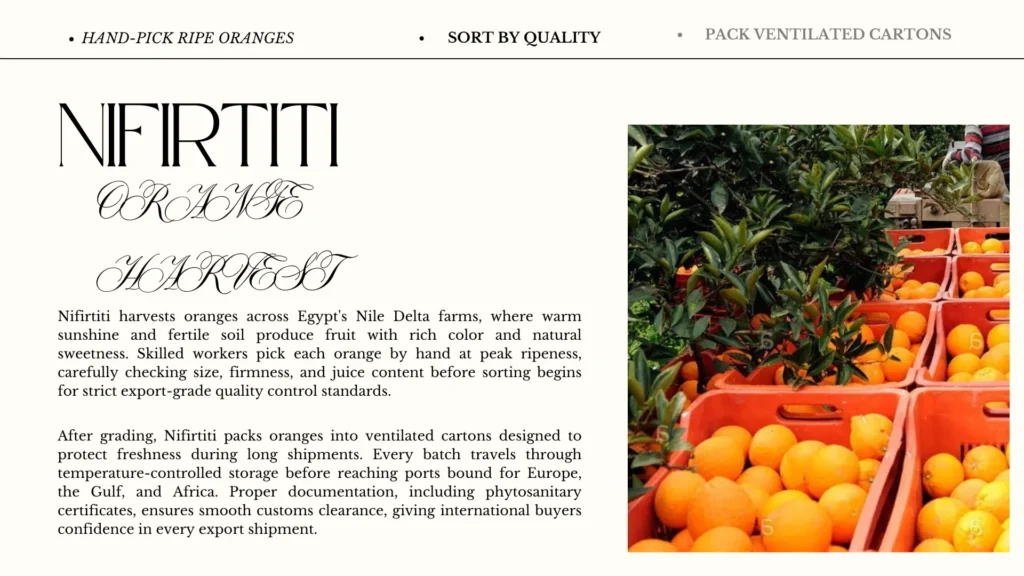
Step 1: Harvest at peak ripeness.s Oranges are picked when sugar content and color meet export-grade thresholds, not on a fixed calendar schedule. Harvesting too early or too late directly affects shelf life and buyer satisfaction.

Step 2: Washing and grading Fruit moves through a washing and waxing process, followed by sorting based on size, color uniformity, and surface quality. Oranges that don’t meet export specifications are typically redirected to domestic or processing markets rather than shipped.

Step 3: Quality and safety inspection. Before packing, fruit is checked against food safety and phytosanitary standards required by destination markets — a step that helps prevent shipment rejection at customs.

Step 4: Packaging Export cartons use food-safe, breathable materials that allow airflow during transit, reducing the risk of spoilage. Labeling is typically customized to match buyer or distributor branding requirements.

Step 5: Cold-chain logistics to the port. Maintaining a consistent temperature from the packhouse to the port loading is one of the most underrated factors in citrus export quality. A break in the cold chain — even briefly — can shorten shelf life significantly by the time fruit reaches its destination.

Practical Tips for Buyers Sourcing From Egypt

  1. Request a sample shipment before committing to a full container — this reveals real-world quality and packaging standards.
  2. Confirm Brix (sugar content) specifications in writing — this is a measurable, objective quality benchmark.
  3. Clarify Incoterms upfront (FOB, CIF, etc.) to avoid disputes over who bears logistics costs and risk.
  4. Ask for traceability documentation — origin-verified produce reduces regulatory risk in markets like the EU.
  5. Plan orders around the December–May Egyptian season to avoid last-minute sourcing gaps

Industry Perspective: Why Origin and Traceability Now Drive Buying Decisions

According to UN Comtrade trade data for fresh citrus (HS code 0805.10), Spain, Egypt, and South Africa rank among the top exporters of fresh oranges by value, with the Netherlands also functioning as a major re-export hub into Europe. That positioning reflects a broader shift in the produce trade: buyers increasingly prioritize verified origin and consistent quality standards over price alone.

This shift matters for any Navel and Valencia orange exporter competing in international markets. Buyers — particularly in the EU and the Gulf — now routinely request traceability records, phytosanitary documentation, and proof of certification before finalizing supply agreements. Industry guidance also points to phytosanitary compliance as a high-priority risk area, since quarantine pest or disease findings can trigger shipment rejection, additional cold-treatment requirements, or seasonal trade restrictions.

For an exporter like Nefartiti, this means compliance isn’t a bureaucratic hurdle — it’s a competitive differentiator. Exporters who can produce clean documentation quickly tend to close deals faster and retain buyers across multiple seasons.

A practical example of how this plays out: A European produce importer sourcing fresh oranges for retail typically evaluates three things before finalizing a new supplier relationship: sample quality against stated Brix levels, consistency of grading across multiple shipments, and speed of documentation turnaround. Exporters that perform well on all three — rather than just offering the lowest price — are the ones that tend to convert a single trial order into a multi-season contract.

Conclusion: Why Nefartiti Orange Export Stands Out in a Crowded Market

The global citrus trade has no shortage of suppliers claiming premium quality. What separates a credible operation from the rest is whether the fundamentals hold up: growing conditions, grading discipline, documentation, and logistics that actually protect fruit quality in transit.

Nefartiti Orange Export is positioned around exactly those fundamentals — sourcing from Egypt’s Nile Delta, offering both Navel and Valencia varieties to serve different buyer needs, and managing the export process from harvest to port with the documentation and cold-chain discipline that international buyers increasingly require.

For importers evaluating a Navel and Valencia orange exporter in today’s market, the right question isn’t simply “how cheap is the fruit?” It’s whether the exporter can consistently deliver graded, certified, traceable product on a predictable timeline — season after season. That consistency is what Nefartiti Orange Export is built to provide.

Frequently Asked Questions

Q1: What orange varieties does Nefartiti Orange Export supply? Nefartiti exports Navel, Valencia, and Baladi oranges sourced from Egypt’s Nile Delta region. Navel oranges suit fresh retail markets for their seedless, easy-to-peel quality, while Valencia oranges are favored for juicing and food service for their higher juice content.

Q2: What is the export season for Egyptian oranges? Egypt’s orange export season typically runs from December through May, giving international buyers a counter-seasonal supply option when other growing regions are between harvests. Buyers should plan procurement schedules around this window to avoid sourcing gaps.

Q3: What certifications should buyers expect from a Navel and Valencia orange exporter? Buyers should confirm current food safety certification, such as GLOBALG.A.P., along with phytosanitary certificates required by the destination country. These documents verify that the fruit meets international safety and quarantine standards before it clears customs.

Q4: How is fruit quality maintained during shipping? Quality is maintained through a cold chain that begins at harvest and continues through washing, grading, packing, and port loading. Any break in temperature control during this process can shorten the fruit’s shelf life by the time it reaches its destination market.

Q5: What should a buyer request before placing a full container order? Buyers should request a sample shipment first, confirm Brix (sugar content) specifications in writing, clarify shipping terms (Incoterms such as FOB or CIF), and request traceability documentation. This reduces risk and verifies that the actual product quality matches what was promised before committing to a larger order.

Suggested Image Alt Text:

  • Image 1: Fresh Navel oranges sorted for export at Nefartiti packing facility
  • Image 2: 
  • Image 3: Valencia oranges being graded for export quality at an Egyptian citrus farm


Fresh Navel oranges sorted for export at Nefartiti packing facility
top orange exporting countries
Nefartiti Orange Export branded cartons ready for international shipment
Nifirtiti Orange Export Farm to Harvest

Our export lineup extends well past this product to cover Garlic, strawberries, Dates, grapes, Mango, Lemon, Onion, Watermelon, Potato, Pomegranate, and Orange,

ExportBureau profile