Nifirtiti: Egypt's Trusted Orange Exporters for Global Markets

This guide covers why Nifirtiti ranks among Egypt’s established orange exporters. It explains the six orange varieties the company ships — Valencia, Washington Navel, Baladi, Sukkari, Salustiana, and Midknight Valencia — and how the Nile Delta and Upper Egypt growing regions extend the Egypt citrus export season from November through June. Readers will learn practical steps for importing oranges from Egypt, packaging and cold-chain standards that protect fruit quality, and common challenges citrus buyers face. The article closes with five frequently asked questions covering certifications, harvest timing, and mold prevention during transit.

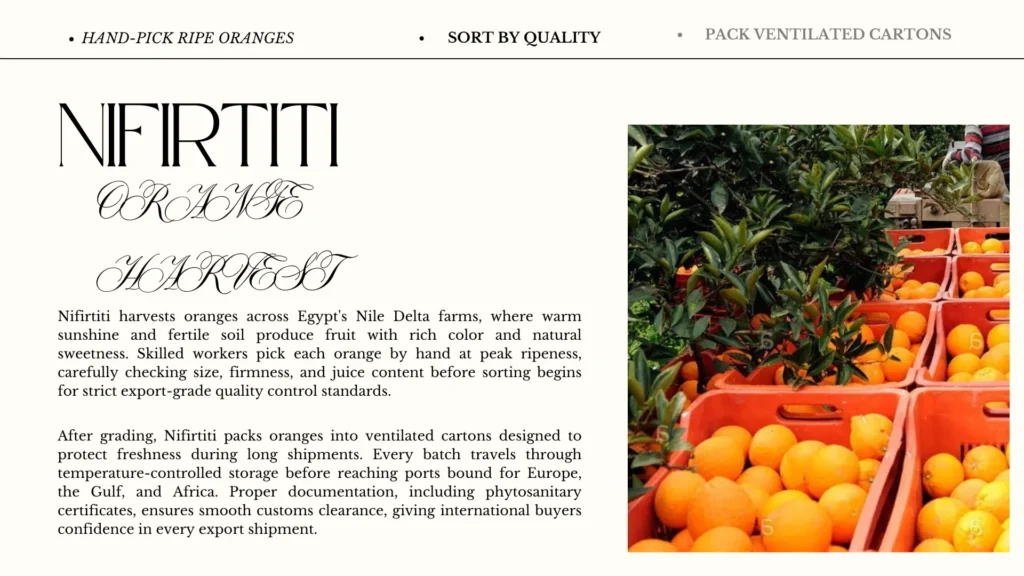
Orange Exporters-Ventilated cartons of Egyptian Navel oranges ready for shipment
Orange Exporters
Brix testing on fresh oranges before export grading
Valencia orange exporters
Nifirtiti Expo

Nifirtiti Expo

Typically replies within a day

Hey, Do you want to talk with us?


Quick Summary: Nifirtiti supplies six Egyptian orange varieties, led by Valencia and Navel, with cold-chain handling and documentation prepared ahead of every shipment. Buyers across Europe, the Gulf, and Asia use the company for both bulk contracts and smaller wholesale orders.

Orange exporters in Egypt have expanded fast over the past decade, and Nifirtiti is one of the names buyers now search for first when they need a dependable supply of fresh citrus. The company ships Valencia, Navel, and other Egyptian orange varieties from the Nile Delta and Upper Egypt to buyers across Europe, the Gulf, and Asia, backed by grading and cold-chain standards that hold up shipment after shipment. Among Egyptian orange exporters, what usually separates the reliable names from the casual traders is documentation and timing: certificates ready before the vessel books, and fruit picked to match each market’s preferred sugar-to-acid ratio.

This guide explains why Egypt has become a major citrus origin, walks through the orange varieties Nifirtiti supplies — including its work as one of the region’s established Valencia orange exporters — and lays out the practical steps an importer needs before booking a container.

Why Egypt Has Become a Leading Source Among Global Orange Exporters

Egypt’s citrus season runs longer than most competing origins, stretching from November through June depending on variety. That long window is a major reason fresh orange exporters Egypt-based have grown their share of the European and Gulf markets over the last ten years.

Climate and Growing Regions Behind Egypt’s Citrus Quality

Two regions supply most of Egypt’s export oranges:

  • Nile Delta (Beheira, Sharqia) — fertile, well-irrigated land that produces the bulk of Egypt’s Valencia and Navel crops.
  • Upper Egypt (Minya, Qena) — warmer daytime temperatures that push sugar content higher and extend harvest into early summer for later varieties.

This regional split is also why citrus exporters Egypt-wide can offer buyers a longer, more reliable supply calendar than single-region competitors. Growers in the Nile Delta typically start picking Navel fruit in November, while orchards in Upper Egypt extend the Valencia harvest into late spring, giving exporters a combined calendar that runs nearly eight months without a real gap.

How Nifirtiti Built Its Reputation as a Trusted Citrus Supplier

Nifirtiti earned its place among Egypt’s trusted citrus suppliers through three habits buyers mention repeatedly:

  1. Grading fruit by size and brix (sugar) level before packing, not just by external appearance.
  2. Running post-harvest fungicide treatment and pre-cooling within hours of picking.
  3. Sharing residue and phytosanitary test results with buyers before the shipment is booked.
  4. Keeping a fixed grower network season to season, so returning buyers get fruit from the same orchards rather than whichever farm has surplus that week.

Orange Varieties Nifirtiti Ships to International Buyers

A single order often blends early and late-season fruit so retailers keep citrus on shelves for most of the year. Here are the varieties Nifirtiti supplies:

  • Valencia — the main late-season juicing and eating orange, with thin skin and high juice content; Egypt’s largest citrus export variety by volume.
  • Washington Navel — seedless, easy to peel, and harvested earlier in the season; a top choice for fresh-eating retail markets.
  • Baladi — a traditional Egyptian variety with a distinct aromatic flavor, popular in Gulf and Middle Eastern markets.
  • Sukkari (Succari) — a low-acid, very sweet orange that some buyers describe as almost sugar-like; increasingly requested by Asian importers.
  • Salustiana — a mid-season, nearly seedless variety with a good balance of sweetness and acidity.
  • Midknight Valencia — a late-season Valencia selection bred for extended storage life, useful for buyers who need fruit into early summer.

As one of the more established Valencia orange exporters in the Nile Delta, Nifirtiti sequences these six varieties so buyers rarely face a gap between the Navel season ending and Valencia season beginning.

Demand patterns differ by market. European retailers tend to favor Navel for fresh-eating displays because it is easy to peel and seedless, while Gulf buyers often request Baladi and Sukkari for their distinct flavor profile. Asian importers increasingly ask about Sukkari specifically, since its low acidity suits markets less accustomed to sharper citrus flavors. Matching variety choice to destination market preference, rather than shipping whatever is available, is one of the simpler ways an exporter earns repeat orders.

What Sets Nifirtiti Apart From Other Orange Exporters

Not every supplier can guarantee brix levels or shelf life twice in a row. Buyers comparing wholesale orange suppliers usually weigh a short list of factors:

  • Grading precision — fruit sorted by both size and sugar content, not size alone.
  • Packaging control — cartons and bags sized to match each destination market’s retail format.
  • Documentation — phytosanitary certificates and residue reports ready before the vessel is booked.
  • Direct grower contracts — fewer intermediaries between the orchard and the packhouse.

Pros and Cons for Importers

  • Pro: Six varieties from one supplier cover most of the export season without switching contracts.
  • Pro: Lab and certification paperwork prepared in advance, which speeds customs clearance.
  • Pro: Grading by brix level reduces the risk of under-ripe or overly acidic fruit reaching retail shelves.
  • Con: Container-level minimum orders may not suit very small first-time buyers.
  • Con: Peak-season bookings for shipping space should be made several weeks ahead.

Buyers researching the best orange exporting companies in Egypt should expect these trade-offs from any serious supplier, not just Nifirtiti — they come with the scale needed to guarantee consistent volume.

Orange Export Packaging Standards and Cold-Chain Handling

Oranges hold up better than most citrus during transit, but quality still depends heavily on how fruit is handled between the orchard and the port.

  • Pre-cooling within hours of harvest removes field heat before fruit reaches the packhouse, slowing decay during the voyage.
  • Post-harvest fungicide dips, applied under approved residue limits, protect against mold during long sea transit.
  • Ventilated cartons sized to each market are a core part of orange export packaging standards, since airflow around the fruit prevents moisture buildup inside the box.
  • Reefer containers set around 4–8°C, depending on variety, keep oranges firm for the three to four weeks a voyage to Europe typically takes.
  • Palletizing to match destination handling equipment avoids repacking at the port, which is a common source of bruising and box damage that buyers often trace back to the wrong carton height rather than the fruit itself.

Buyers who ask about brix testing and packaging specs before booking are far more likely to receive fruit that matches the sample they were shown.

Practical Steps to Import Oranges From Nifirtiti

Citrus shipments are less time-sensitive than soft fruit, but the process still benefits from a clear order of steps:

  1. Confirm the variety and season window. Navel ships from November through February; Valencia and Midknight Valencia extend into May and June.
  2. Request samples and brix reports. Ask for a recent sugar-acid ratio test alongside a grading sample before confirming volume.
  3. Agree on carton specs. Ventilation, carton weight, and pallet layout should match your destination market’s retail standard.
  4. Choose the shipping method. Sea freight in ventilated or refrigerated containers covers most orders; air freight is rarely needed for oranges given their longer natural shelf life.
  5. Confirm certificates before loading. Phytosanitary and residue documentation should be finalized before the container is sealed.
  • Check the route and transit time. Review the shipping schedule for orange exporters to Europe, since transit times and port congestion vary by season and route.

Buyers who follow this sequence avoid the two most common citrus import delays: missing certificates at the destination port and carton specifications that don’t match local retail shelving.

Real-World Example: Supplying a Year-Round Citrus Program

A Gulf-based wholesale distributor needed oranges on shelves nearly year-round without constant supplier changes. Nifirtiti sequenced Washington Navel through the winter months, moved into Valencia by early spring, and closed the program with Midknight Valencia into early summer. Because brix testing and phytosanitary paperwork were prepared ahead of each shipment, the distributor’s team cleared containers faster at the port and avoided the stop-start ordering pattern that comes from working with several smaller, less organized suppliers. Over the course of the program, the distributor also reported fewer rejected pallets at receiving, since fruit consistently matched the brix and size specifications agreed on before each shipment left Egypt — a detail that matters more to a wholesale buyer than any single low price quote.

Common Challenges Facing Citrus Exporters (And How Nifirtiti Solves Them)

  • Challenge: Inconsistent sweetness between shipments. Solution: grading by brix level, not appearance alone, before packing.
  • Challenge: Mold during long sea transit. Solution: approved post-harvest fungicide treatment combined with proper ventilation.
  • Challenge: Delayed customs clearance. Solution: preparing phytosanitary and residue documentation before the vessel is booked.
  • Challenge: Seasonal supply gaps. Solution: sequencing Navel, Valencia, and Midknight Valencia varieties across the season.

Exporters that manage these four risks consistently are the ones wholesale buyers keep returning to season after season.

Conclusion

Choosing among orange exporters comes down to whether a supplier can repeat the same grading, packaging, and documentation standard on every shipment, not just the first one. Nifirtiti’s six-variety lineup, brix-based grading, and paperwork prepared ahead of shipping are why buyers across Europe, the Gulf, and Asia continue working with the company season after season. For importers comparing suppliers this year, the steps above — confirming season windows, requesting brix samples, and locking carton specs early — are the same standard to expect from any of Egypt’s serious citrus exporters.

Frequently Asked Questions

1. Which orange varieties does Nifirtiti export?

Nifirtiti ships six varieties: Valencia, Washington Navel, Baladi, Sukkari, Salustiana, and Midknight Valencia, covering most of the Egypt citrus export season from November through June.

2. When does the Egyptian orange export season run?

Washington Navel ships first, from November through February, while Valencia and Midknight Valencia extend the season into May and June.

3. What certifications should buyers request from Egyptian orange exporters?

Ask for a phytosanitary certificate, GlobalG.A.P. documentation, and a recent residue test report before confirming a shipment. Buyers working with new suppliers should also request a sample copy of each document in advance, rather than waiting until the container is ready to load.

4. How are oranges protected from mold during long shipping distances?

Approved post-harvest fungicide treatment, proper pre-cooling, and ventilated packaging together reduce the risk of mold during multi-week sea transit. Reefer temperature logs shared with the buyer on arrival also make it easy to confirm the cold chain was maintained throughout the voyage.

5. Do navel orange suppliers ship earlier than Valencia suppliers?

Yes. Navel oranges are harvested earlier in the season, typically from November, while Valencia is a later-season variety that ships from around February through June.

Suggested Image Alt Text

  • Fresh Valencia oranges packed for export by Nifirtiti
  • Nile Delta orange orchard rows in Egypt
  •  
  •  
  • Refrigerated container loading Egyptian citrus for export
  • Nifirtiti packhouse worker inspecting orange cartons for export
Fresh Navel oranges sorted for export at Nefartiti packing facility
navel orange suppliers

Sourcing more than one crop? Our certified farms in Egypt also grow and export Garlic, strawberries, grapes, Dates, Mango, Lemon, Onion, Watermelon, Potato, and Pomegranate.

ExportBureau profile