
Nifirtiti: Egypt's Leading Mango Exporters Year-Round
This guide explains why Nifirtiti ranks among Egypt’s leading mango exporters. It covers the ten export varieties the company ships — Keitt, Kent, Tommy Atkins, Naomi, Zebdia, Ewais, Sideeka, Alphonso, Awees, and Fagr Kalan — why Egypt’s staggered harvest gives it a seven-month export window, and the GlobalG.A.P and HACCP certification serious buyers require. Readers will learn packaging standards, cold-chain shipping practices, and the practical steps for importing mangoes from Egypt, along with real market data on production, varieties, and destination preferences. The article closes with five frequently asked questions covering certifications, shipping seasons, packaging, and minimum order quantities.
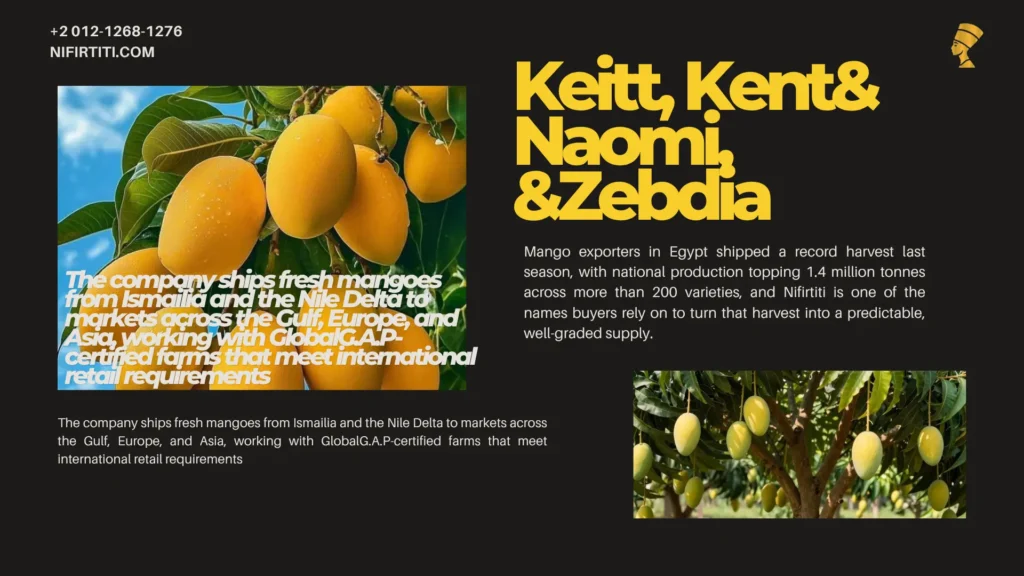
Why Egypt Has Become a Major Force Among Global Mango Exporters
Egypt’s edge among mango exporters is timing. The country’s growing regions produce a staggered harvest that begins in late spring and extends into early winter, allowing Egyptian growers to supply markets during months when Latin American and Asian origins have already finished their seasons. Total mango-growing area in Egypt now covers around 137,000 hectares, and the crop ranks among the country’s most important fresh fruit exports.
How Egypt’s Mango Season Actually Works
The harvest moves through distinct phases rather than arriving all at once:
- Late May to June — early local varieties such as Sukkari and Baladi open the season.
- June to July — Ewais and Tommy Atkins become the first varieties widely available for export.
- July to August — peak season, with Alphonso, Zebdia, Naomi, and Sideeka all in heavy supply.
- August to December — Keitt and Kent extend the export window well past when most competing origins have stopped shipping.
This spread is exactly what allows a fresh mango export company to promise buyers continuous supply rather than a single six-week window.
How Nifirtiti Built Its Reputation as a Trusted Supplier
Fresh mango export companies compete on more than price. Nifirtiti earned trust through habits buyers notice on repeat orders:
- Harvesting at the correct maturity stage for each variety, since mangoes picked too early never develop full sugar content.
- Grading by size — export-grade fruit is generally sized above 300 grams — before packing, not after a complaint.
- Matching variety to destination: Keitt and Kent for late-season EU and Russian demand, Zebdia and Awees for Gulf markets that prefer a sharper, sour-sweet profile.
Best Mango Variety for Export: What Nifirtiti Ships
Buyers rarely want just one variety, since the Egyptian season is really ten overlapping windows. Here is what Nifirtiti supplies:
- Keitt — Egypt’s flagship late-season variety, with the longest availability window of any type, running from August into December. It reaches export markets when competing origins have already run out of supply, which makes it one of the most requested varieties in the trade.
- Kent — pairs with Keitt as the other main late-season option, available from August onward, with a smooth, fiberless flesh that European retailers favor.
- Tommy Atkins — an early-to-mid season variety known for firm flesh and strong shipping durability, making it a reliable choice for long sea voyages.
- Naomi — a widely exported mid-season variety with strong demand from both Arab and EU/Russian markets, valued for its balanced sweetness.
- Zebdia (Zebda) — traditionally a local, juicier and softer variety used mainly for juicing, but increasingly exported to Arab markets that prefer its sour-sweet profile.
- Ewais — a distinctly Egyptian variety with a sweet-and-sour flavor and tender, juicy flesh, commercially significant both domestically and for export.
- Sideeka (Sadiqah) — another native variety shipped in the mid-season window, prized for its aromatic flesh.
- Alphonso — the Egyptian-grown type, a premium peak-season variety distinct from the Indian original but sharing its rich, smooth texture.
- Awees (Awisi) — an early-to-mid season variety especially popular in Arab markets.
- Fagr Kalan — a later-season variety that exporters are leaning into more heavily as they push to extend the export window further into winter.
This ten-variety range is one reason Nifirtiti is regularly named among the best mango varieties for export choices when buyers compare Egyptian suppliers against origins like Peru, Brazil, and Pakistan.
What Sets Nifirtiti Apart From Other Mango Exporters
Not every fresh mango export company can guarantee the same fruit twice. Buyers comparing suppliers usually weigh a short list of factors:
- Certification — GlobalG.A.P and HACCP compliance, which EU and Gulf retailers increasingly treat as a baseline requirement, not a bonus.
- Cold-chain discipline — fruit moved into controlled cold storage shortly after harvest to slow ripening before it reaches the packhouse.
- Packaging control — cartons sized and labeled to match each destination market’s retail standard, whether retail-ready or bulk mango for export.
- Variety matching — routing Keitt and Kent to late-season EU demand and Zebdia or Awees to Gulf buyers, instead of a one-size-fits-all shipment.
Pros and Cons for Importers
- Pro: Ten varieties spanning a seven-month season, reducing the need to switch suppliers between windows.
- Pro: A.P and HACCP certification lowers the risk of shipments being rejected at EU customs.
- Pro: Variety-matched sourcing means fewer complaints about fruit not suiting the intended market.
- Con: Peak months (July–August) see the heaviest demand, so booking reefer or air freight space early matters.
- Con: Container minimums may not suit very small, first-time buyers without a partner to combine orders.
Buyers searching for mango exporters near me on a map should still apply these same checks to any local sourcing agent, since certification and variety matching matter more than physical proximity to a port.
Mango Export Packaging Standards
Packaging protects fruit that bruises easily and ripens quickly in transit. Standard formats used across the trade include:
- 4 to 6 kg retail-ready cartons — the most common format for supermarket shelf display, sometimes with custom branding.
- 10 kg bulk wholesale cartons — used for foodservice and repacking buyers who don’t need retail-ready presentation.
- 3 kg open-top plastic boxes — a lighter option for premium or short-shelf-life varieties like Alphonso.
- Size grading above 300 grams — the standard export threshold, which keeps fruit consistent across a shipment and matches what most international buyers expect.
Agreeing on packaging format and size grade before the first shipment avoids the most common dispute in the trade: a buyer expecting retail cartons receiving bulk boxes instead.
Mango Shipping and Cold-Chain Logistics
Mangoes ripen quickly once picked, so the hours right after harvest determine how much shelf life a shipment has left by the time it reaches a buyer.
- Pre-cooling shortly after harvest slows the ripening process and gives exporters more control over how firm the fruit is when it lands.
- Sea freight in reefer containers is standard for most volume orders, with controlled temperature and humidity for voyages that can run several weeks to Europe or the Gulf.
- Air freight is reserved for premium, short-shelf-life varieties or first-time sample orders, since it costs more but preserves peak ripeness.
- Continuous temperature logging during the voyage gives buyers a documented record if any shipment arrives underperforming.
Buyers who confirm pre-cooling times and shipping method before ordering are far more likely to receive fruit at the ripeness stage they expected.
Practical Steps to Import Mangoes From Nifirtiti
- Confirm the variety and season window. Tommy Atkins and Ewais open the season in June; Keitt and Kent run the latest, from August through December.
- Request a sample shipment. A small air-freight box lets you verify ripeness, flavor, and fiber content before committing to volume.
- Agree on packaging format. Choose between retail-ready cartons and bulk wholesale boxes, and confirm size grading above 300 grams.
- Lock in the shipping method. Reefer sea freight suits most volume orders; air freight is reserved for premium or short-shelf-life runs.
- Verify certification before loading. A.P and HACCP documentation, along with any required import permits, should be confirmed before the container seals.
- Track the cold chain. Request a temperature log for the voyage so any deviation is documented rather than disputed after arrival.
Buyers who follow these six steps in order avoid the two most common import delays: mismatched packaging expectations and fruit that arrives overripe because pre-cooling was skipped.
Real-World Example: Extending a Season With Late Varieties
A recent order for a European retailer needed mangoes available past the point when most competing origins had finished shipping. Nifirtiti sequenced the order around Keitt and Kent, both of which remain available from August into December, letting the retailer maintain shelf presence through a window most suppliers can’t fill. The same account had struggled the previous year with a supplier who offered only early-season varieties, leaving a supply gap from September onward. Switching to a Nifirtiti mango supplier relationship closed that gap without the retailer needing to source from a second country.
Common Challenges Facing Mango Exporters (And How Nifirtiti Solves Them)
- Challenge: Fruit over-ripening in transit. Solution: pre-cooling immediately after harvest and matching the shipping method to shelf-life needs.
- Challenge: Inconsistent sizing between shipments. Solution: grading to the 300-gram-plus export standard before packing, shared with buyers in advance.
- Challenge: Variety mismatched to market. Solution: routing Keitt and Kent to late-season EU demand and Zebdia or Awees to Gulf buyers as standard practice.
- Challenge: Seasonal supply gaps. Solution: sequencing all ten varieties across the full June-to-December window to avoid a single point of failure.
Conclusion
Choosing among mango exporters comes down to whether a supplier can match the right variety, ripeness, and packaging to your market, order after order, not just deliver one good container. Nifirtiti’s ten-variety lineup, GlobalG.A.P-certified sourcing, and variety-matched shipping are why buyers across the Gulf, Europe, and Asia keep a Nifirtiti mango supplier relationship on their shortlist through every phase of the season. For importers weighing options this year, the same checks apply whether Nifirtiti or another exporter is under consideration: confirm the variety window, request a sample, and agree on packaging before the first container ships.
Frequently Asked Questions
1. What mango varieties does Nifirtiti export?
Nifirtiti ships ten main export varieties: Keitt, Kent, Tommy Atkins, Naomi, Zebdia, Ewais, Sideeka, Alphonso, Awees, and Fagr Kalan, covering the full Egyptian season from June through December.
2. When does the Egyptian mango export season run?
The season opens in June with Tommy Atkins and Ewais, peaks in July and August with Alphonso, Zebdia, Naomi, and Sideeka, and extends the latest with Keitt and Kent, which remain available from August through December.
3. What certification should buyers verify before ordering?
Ask for GlobalG.A.P and HACCP certification, both of which EU and Gulf retailers increasingly require as a baseline for fresh produce imports.
4. What packaging formats are standard for mango exports?
Most shipments use 4 to 6 kg retail-ready cartons or 10 kg bulk wholesale cartons, with export-grade fruit generally sized above 300 grams.
5. Is there a minimum order quantity for wholesale mango suppliers?
Minimum orders are typically set at container level for sea freight, though sample boxes are usually available by air freight for quality verification first.
Suggested Image Alt Text
- Fresh Keitt mangoes packed for export by Nifirtiti
- Kent mango orchard in Ismailia ready for harvest
- Reefer container loading Egyptian mangoes for export
- Hand-graded Naomi mangoes before export packing
- Tommy Atkins mango cluster ready for international shipment
- A.P certified mango packhouse in Egypt
Curious what else we grow? Our farms also produce Garlic, strawberries, Dates, Mango, Lemon, Onion, Watermelon, grapes, Potato, Pomegranate, and Orange, for buyers around the world.