
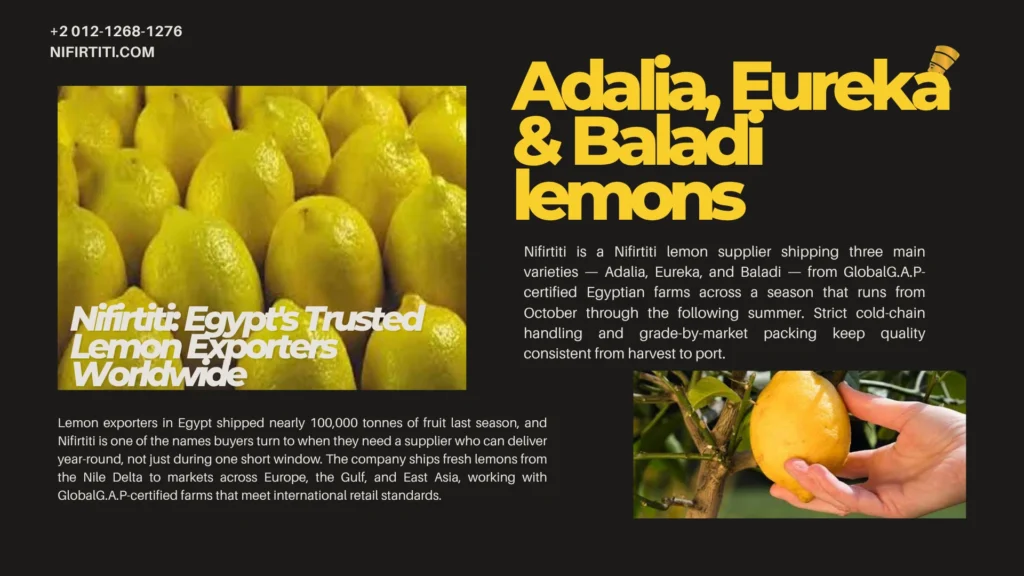
Nifirtiti: Egypt's Trusted Lemon Exporters Worldwide
This guide explains why Nifirtiti ranks among Egypt’s leading lemon exporters. It covers the four varieties the company ships — Adalia, Eureka, Baladi, and Verna — why Egypt’s staggered harvest gives it near year-round supply, and the GlobalG.A.P certification serious buyers require. Readers will learn packaging standards, cold-chain shipping practices, and the practical steps for importing lemons from Egypt, along with real market data on volumes, varieties, and destination preferences. The article closes with five frequently asked questions covering certifications, shipping seasons, packaging, and minimum order quantities.

Why Egypt Has Become a Major Force Among Global Lemon Exporters
Egypt’s real advantage is not one big harvest — it is year-round availability. Multiple growing regions with staggered harvest cycles mean Egyptian growers can ship fruit every month of the year, a supply pattern few competing origins can match. That continuity is why Egypt has grown into one of the most relied-upon origins for wholesale lemon suppliers stocking retail programs that cannot afford a sourcing gap.
How Egypt’s Lemon Season Actually Works
The main harvest window runs differently depending on variety:
- Adalia — Egypt’s highest-volume export variety, ripening from late November through late February, giving buyers a strong winter supply window.
- Eureka — cropped through a longer stretch of the year, prized for consistent quality that suits long-distance shipping.
- Summer production — lemons harvested outside the main window carry slightly more green coloration on the peel, which does not affect internal quality, and often command higher prices because fewer competing origins are shipping at that time.
This staggered pattern is what lets a fresh lemon export company promise continuous supply instead of a single seasonal burst.
How Nifirtiti Built Its Reputation as a Trusted Supplier
Fresh lemon export companies compete on more than price. Nifirtiti earned trust through habits buyers notice on repeat orders:
- Hand-picking to prevent skin damage, since bruised rind shortens shelf life fast.
- Sorting in-field for grade before the fruit ever reaches the packhouse.
- Matching variety to market — Eureka for European retail, Baladi and Adalia for Gulf and processing buyers — instead of shipping one blend to everyone.
Best Lemon Variety for Export: What Nifirtiti Ships
Buyers rarely want a single variety, since each suits a different market and use case. Here is what Nifirtiti supplies:
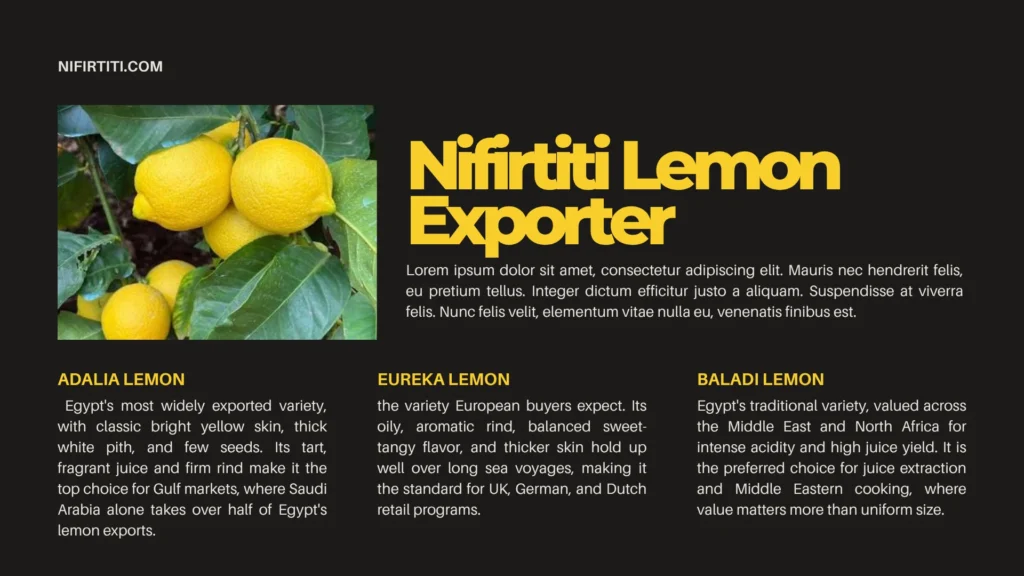
- Adalia Lemon — Egypt’s most widely exported variety, with classic bright yellow skin, thick white pith, and few seeds. Its tart, fragrant juice and firm rind make it the top choice for Gulf markets, where Saudi Arabia alone takes over half of Egypt’s lemon exports.
- Eureka Lemon — the variety European buyers expect. Its oily, aromatic rind, balanced sweet-tangy flavor, and thicker skin hold up well over long sea voyages, making it the standard for UK, German, and Dutch retail programs.
- Baladi Lemon — Egypt’s traditional variety, valued across the Middle East and North Africa for intense acidity and high juice yield. It is the preferred choice for juice extraction and Middle Eastern cooking, where value matters more than uniform size.
- Verna Lemon — a smaller-volume variety still grown by some Egyptian exporters, offering a useful supplementary supply during gaps in the main season.
This four-variety range is one reason Nifirtiti is often named among the best lemon variety for export choices when buyers compare Egyptian suppliers against origins like Spain, Turkey, and South Africa.
What Sets Nifirtiti Apart From Other Lemon Exporters
Not every fresh lemon export company can guarantee the same fruit twice. Buyers comparing suppliers usually weigh a short list of factors:
- Certification — GlobalG.A.P compliance, which UK and EU retailers treat as a baseline requirement, not a bonus.
- Cold-chain discipline — fruit moved into reefer storage around 10°C to 12°C shortly after grading, not left exposed on open pallets.
- Packaging control — cartons sized and labeled to match each destination market’s retail count standard.
- Variety matching — supplying Eureka to Europe and Baladi or Adalia to Gulf buyers, instead of a one-size-fits-all shipment.
Pros and Cons for Importers
- Pro: Three to four varieties available across a near year-round window, reducing the need to switch suppliers between seasons.
- Pro:A.P certification lowers the risk of shipments being rejected at EU customs.
- Pro: Variety-matched sourcing means fewer complaints about fruit not suiting the intended market.
- Con: Peak winter months see heavy demand from Gulf buyers, so booking reefer space early matters.
- Con: Container minimums may not suit very small, first-time buyers without a partner to combine orders.
Buyers searching for lemon exporters near me on a map should still apply these same checks to any local sourcing agent, since certification and variety matching matter more than physical proximity to a port.
Lemon Export Packaging Standards
Packaging protects fruit that bruises easily during a multi-week voyage. Standard formats used across the trade include:
- 15 kg telescopic cartons — the most common format for retail-ready fruit, sometimes labeled 15kg net weight, 16kg gross weight to account for the box itself.
- Plastic boxes — used by some exporters as an alternative to cartons, offering more structural protection for longer routes.
- Automated sizing counts from 80 to 138 — giving buyers a consistent calibre in every carton, with counts of 95 to 125 most requested for European retail.
- Class A, Seedless, and Class B grading — letting buyers choose premium fruit for retail or cost-effective grades for bulk lemon for export destined to processing lines.
Agreeing on packaging specs and count size before the first shipment avoids the most common dispute in the trade: a buyer expecting one carton size receiving another.
Lemon Shipping and Cold-Chain Logistics
Lemons hold up better than many citrus fruits during transport, but only if the cold chain starts at the right temperature.
- Reefer containers held at 10°C to 12°C are the standard setting for lemon shipments, cooler than ambient but not as cold as leafy produce, since lemons are sensitive to chilling injury below this range.
- Washing, waxing, and fungicidal treatment where required protect the rind for the full voyage while meeting GlobalG.A.P standards.
- Continuous temperature logging during the voyage gives buyers a documented record if any container arrives underperforming.
- Sample shipments by air freight let first-time buyers verify quality on a 5 to 10 kg box before committing to a full container order.
Buyers who confirm reefer settings and request a sample before their first order are far more likely to receive fruit that matches expectations on the first full container.
Practical Steps to Import Lemons From Nifirtiti
- Confirm the variety and season window. Adalia peaks from late November through February; Eureka and Baladi are available across a longer stretch of the year.
- Request a sample shipment. A small air-freight box lets you verify color, juice content, and rind quality before committing to volume.
- Agree on packaging and count size. Confirm carton weight and size counts (80–138) against your destination market’s retail standard.
- Lock in the shipping method. Reefer sea freight at 10°C to 12°C is standard for most orders; air freight is reserved for samples or premium short runs.
- Verify certification before loading.A.P documentation and any required import permits should be confirmed before the container seals.
- Track the cold chain. Request a temperature log for the voyage so any deviation is documented rather than disputed after arrival.
Buyers who follow these six steps in order avoid the two most common import delays: mismatched packaging specs and certification gaps discovered only at the destination port.
Real-World Example: Supplying Two Markets From One Season
A recent order split a single harvest between two very different buyers: a UK retailer wanting uniform Eureka lemons in counts of 95 to 125 for supermarket shelves, and a Gulf foodservice distributor wanting Baladi lemons by the ton with less concern for size uniformity. Because Nifirtiti sorts by grade and variety before packing rather than after, both orders shipped from the same harvest window without either buyer receiving fruit suited to the other’s market. The UK order cleared retail inspection on the first pass, and the Gulf order arrived with the strong acidity and juice yield the distributor’s kitchens needed.
Common Challenges Facing Lemon Exporters (And How Nifirtiti Solves Them)
- Challenge: Rind damage during harvest and handling. Solution: hand-picking to prevent oleocellosis, the oil-gland damage that shortens shelf life.
- Challenge: Inconsistent sizing between shipments. Solution: automated sizing to a fixed count range, agreed with buyers before the order ships.
- Challenge: Mismatched variety and market. Solution: routing Eureka to Europe and Baladi or Adalia to Gulf and processing buyers as a standard practice, not a special request.
- Challenge: Seasonal supply gaps. Solution: sequencing Adalia, Eureka, Baladi, and Verna across staggered harvest windows to maintain year-round supply.

Explore variety details at Nefertiti Lemon Export Company, or browse related citrus on Orange Exporters. Buyers sourcing citrus often add our dates to the same container.
A Byproduct Worth Knowing About
Lemon trees are pruned annually to maintain fruit yield, and the trunk and branch wood removed in the process is collected rather than discarded. Nifirtiti carbonizes it into export-grade natural lump charcoal, sourced from the same certified orchards — alongside wood from our mango, orange, and grape farms.
PRODUCT SPECIFICATIONS
Lemon Variety Spec Sheet
Three main export varieties, each suited to a different market window.
Variety | Diameter | Packaging | Season |
Eureka Lemon Juicy, thin skin | 53–67mm | 10kg / 15kg cartons | Oct – Apr |
Baladi Lemon Aromatic, traditional | 49–58mm | 10kg cartons | Jun – Sep peak |
Adalia Lemon Extended shelf life | 53–63mm | 10kg / 15kg cartons | Oct – Mar |
EXPORT PROCESS
From Inquiry to Loaded Container
Standard order timeline across all three varieties.
Step | Timing | Stage | What Happens |
1 | Day 0 | Inquiry & Sample Request | Specify variety, size, and destination Incoterm. |
2 | Day 1–2 | Quotation & Proforma | FOB / CFR / CIF quote issued, proforma confirms schedule. |
3 | Day 3–5 | Grading, Packing & QC | Size and juice-content grading, pre-cooling, carton packing. |
4 | Day 5–7 | Certification & Documentation | Phytosanitary certificate and residue report finalized. |
5 | Day 7+ | Loading & Shipment | Reefer container loaded, tracking and shipping docs shared. |
Conclusion
Choosing among lemon exporters comes down to whether a supplier can match the right variety to the right market, order after order, not just deliver one good container. Nifirtiti’s four-variety lineup, GlobalG.A.P-certified sourcing, and grade-by-market packing are why buyers across Europe, the Gulf, and Asia keep a Nifirtiti lemon supplier relationship on their shortlist through every season. For importers weighing options this year, the same checks apply whether Nifirtiti or another exporter is under consideration: confirm the variety window, request a sample, and agree on packaging before the first container ships.
Frequently Asked Questions
1. What lemon varieties does Nifirtiti export?
Nifirtiti ships four main varieties: Adalia, Eureka, Baladi, and Verna, covering a supply window that runs from late autumn through summer.
2. When does the Egyptian lemon export season run?
Adalia peaks from late November through late February, while Eureka and Baladi are available across a longer stretch of the year, giving Egypt near year-round supply.
3. What certification should buyers verify before ordering?
Ask for GlobalG.A.P certification, which UK and EU retailers require as a baseline, along with confirmation of the grading class (A, Seedless, or B) for your intended use.
4. What packaging formats are standard for lemon exports?
Most shipments use 15 kg telescopic cartons or plastic boxes, with automated sizing giving counts between 80 and 138, and counts of 95 to 125 most common for European retail.
5. Is there a minimum order quantity for wholesale lemon suppliers?
Minimum orders are typically set at container level for sea freight, though sample boxes of 5 to 10 kg are usually available by air freight for quality verification first.